A customer looking for a product no longer has to open Google, visit several websites, and compare dozens of listings manually. They can ask ChatGPT, Gemini, Perplexity, or another AI assistant:
- “What is the best coffee machine under $500?”
- “Compare these three B2B marketplace platforms.”
- “Find a sustainable clothing store that ships to Germany.”
- “Which replacement part is compatible with this appliance?”
The AI system can research the options, summarize their differences, and recommend several products or companies. If your store is not included in that answer, the customer may never reach your website.
This change has created a new discipline: generative engine optimization, or GEO.
The shift is already affecting eCommerce. According to Shopify, referral sessions from AI chatbots grew more than eightfold year over year, while orders attributed to AI referrals increased almost thirteenfold. BigCommerce also reports that 67% of surveyed eCommerce leaders have noticed a measurable decline in organic search traffic and are changing their strategies in response.
GEO does not mean abandoning Google or replacing your existing SEO strategy. It means preparing your website for a search environment in which visibility can come from an AI-generated recommendation, comparison, or answer—not only from a traditional list of links.
Key Takeaways
- GEO helps AI-powered search systems discover, understand, and accurately represent a business.
- GEO complements SEO rather than replacing it. Strong technical SEO remains the foundation of AI visibility.
- For eCommerce websites, complete product data, structured information, reviews, expert content, and independent brand mentions are especially important.
- AI systems evaluate information from multiple sources, not only from a company’s official website.
- GEO performance should be measured through citations, brand mentions, referral traffic, assisted conversions, and accuracy—not rankings alone.
No technique can guarantee that an AI platform will recommend a particular product or company.
What Is Generative Engine Optimization?
Generative engine optimization is the process of making a company, website, and its content easier for generative AI systems to discover, understand, trust, and use in their answers.
Traditional SEO aims to place a webpage near the top of search results. GEO aims to have a brand, product, or source included in an AI-generated response.
This response might contain:
- A direct mention of the company
- A link to a product or article
- A summary of information from the website
- A comparison with competing products
- A recommendation for a particular use case
- A citation supporting a statement
- Product information such as price, availability, or specifications
GEO applies to platforms such as ChatGPT, Google AI Overviews and AI Mode, Gemini, Perplexity, Microsoft Copilot, and other services that combine generative models with web search or information retrieval.
The important difference is that an AI system does not always send the user to the original source. It may collect information from several websites and present a complete answer within the conversation.
For example, a search engine might display ten links for the query “best marketplace platform for a B2B distributor.” An AI assistant may instead compare three platforms, explain their differences, and recommend one based on the user’s budget and business model.
In that situation, visibility means more than ranking. A company needs to be understood well enough to be included in the comparison—and represented accurately when it appears.
Read more: AI in eCommerce: How Artificial Intelligence Is Transforming Online Shopping
GEO vs. SEO vs. AEO
GEO is often discussed alongside search engine optimization and answer engine optimization. These approaches overlap, but they focus on different forms of visibility.
| Approach | Primary goal | Typical result | Important signals |
| SEO | Rank a webpage in search results | Search listing and website visit | Relevance, links, technical quality, user experience |
| AEO | Provide a concise answer to a specific question | Featured snippet, voice answer, or direct response | Clear definitions, structured answers, entities |
| GEO | Be included in an AI-generated response | Mention, citation, comparison, or recommendation | Retrievable facts, authority, consistency, independent evidence |
A single page can support all three.
A detailed product comparison, for example, can rank in conventional search, provide a short answer for a featured snippet, and supply facts that an AI system uses when recommending a product.
Google does not treat GEO as a replacement for SEO. Its official guidance says that the same fundamentals that help websites succeed in regular search also apply to AI Overviews and AI Mode. These include technical accessibility, useful original content, a good page experience, and accurate structured data.
In other words, businesses do not need a completely separate website for AI search. They need to strengthen the quality, clarity, and credibility of the website they already have.
How Generative Engines Find Information
The exact mechanisms differ by platform, but a typical AI-search process includes several stages.
1. The system interprets the request
Conversational queries often contain more context than traditional search terms.
A customer might type “running shoes” into a search engine but ask an AI assistant: “What running shoes are suitable for flat feet, cost less than $150, and are available in Europe?”
The system must identify the product category, customer need, budget, and location before looking for suitable information.
2. It retrieves relevant sources
When web search or retrieval is available, the system looks for pages that may help answer the request. These can include:
- Product and category pages
- Manufacturer websites
- Buying guides
- Comparison articles
- Marketplaces
- Reviews
- Forums
- News publications
- Industry directories
- Research reports
This means that a company’s visibility is influenced by both its own website and what reliable external sources say about it.
3. It extracts relevant facts
The system identifies useful passages and data, such as:
- Product specifications
- Prices
- Shipping regions
- Customer ratings
- Compatibility information
- Return conditions
- Company descriptions
- Advantages and limitations
Pages with vague marketing statements may provide less usable information than pages with concrete, verifiable details.
“Built for growing businesses” is difficult to evaluate. “Supports more than 1,000 storefronts from one administration panel” gives the system a specific fact it can use in a comparison—provided the statement is accurate and supported.
4. It compares sources
Generative systems may combine information from multiple websites rather than rely on a single page.
For example, the official website may explain a product’s functionality, a customer case may show how it performs in practice, and an independent review may provide an external assessment.
Agreement between reliable sources makes a claim easier to verify. Conflicting prices, descriptions, product names, or company details can reduce confidence.
5. It generates the answer
The final response is created for the particular user request. It may summarize information, compare alternatives, cite several sources, or recommend a product for a specific situation.
The result can change when the wording, platform, location, or date changes. A company that appears for one prompt will not necessarily appear for every similar request.
That is why GEO should be treated as an ongoing visibility program rather than a one-time page optimization.
Why GEO Matters for eCommerce
AI search is particularly relevant to eCommerce because purchasing decisions involve questions, comparisons, and tradeoffs.
Customers rarely want a product in isolation. They want the right product for a particular task, budget, location, or set of requirements.
Generative systems are well suited to requests such as:
- “Which camera is best for a beginner who mainly records video?”
- “Compare these two laptops for software development.”
- “Find a marketplace that sells verified refurbished electronics.”
- “What is the best eCommerce platform for a marketplace with regional vendors?”
- “Which supplier can deliver this component within the EU?”
- “Is this product compatible with the model I already own?”
These searches can occur throughout the customer journey.
Product discovery
The customer describes a need instead of entering a product name. The AI system suggests categories, products, or brands that may solve the problem.
Learn more: Why Is Duplicate Product Description a Threat to Your eCommerce SEO?
Product comparison
The customer asks the system to compare prices, features, reviews, delivery conditions, or compatibility. Complete and current product data becomes critical at this stage.
Vendor or platform selection
A business buyer may ask for suppliers or software platforms that meet a detailed list of requirements. The AI can create an initial shortlist before the buyer visits any company website.
Purchase validation
A customer who has already found a product may ask whether it is reliable, appropriately priced, or suitable for a particular use.
Post-purchase support
Customers may use AI to find instructions, compatibility details, spare parts, or troubleshooting information. Clear documentation can keep the company visible after the initial sale.
This also creates an attribution problem. A customer may discover a brand through ChatGPT, research it on review sites, return through a branded Google search, and finally purchase directly. Analytics might attribute the order to organic or direct traffic even though AI influenced the original decision.
For that reason, GEO cannot be evaluated by AI referral traffic alone.
How to Use GEO for an Online Store or Marketplace
Effective GEO starts with information that AI systems can access and interpret. Content tactics will have limited value if essential product and business information is hidden, incomplete, inconsistent, or technically inaccessible.
1. Make Important Pages Accessible
AI-powered search systems often depend on conventional web indexes and retrieval infrastructure. If search engines cannot crawl and index a page, that page is also less likely to become a useful source for AI-generated answers.
Start with the same technical foundation required for SEO:
- Allow crawling of important public pages.
- Use clear, permanent URLs.
- Add product, category, vendor, and content pages to XML sitemaps.
- Set canonical URLs correctly.
- Avoid accidental noindex directives.
- Link important pages from the website’s navigation and related content.
- Ensure that essential information is available in rendered HTML.
- Maintain acceptable loading speed and page stability.
- Redirect discontinued URLs to a relevant replacement when appropriate.
Pay particular attention to faceted navigation. Filters can create thousands of low-value URL combinations, while useful filtered categories may remain inaccessible or lack unique information. Decide which pages should be indexable based on real customer demand.
Marketplaces should also review seller storefronts. If seller pages are isolated from the main catalog or accessible only through internal search, crawlers may have difficulty discovering them.
Does an eCommerce website need an llms.txt file?
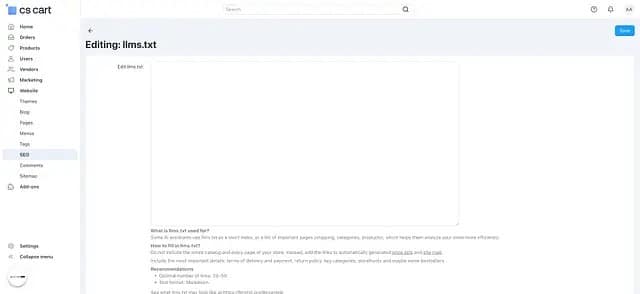
An llms.txt file has been proposed as a way to provide AI systems with a curated description of a website. However, it is not a universal standard, and adding one does not guarantee visibility in AI answers.
Google explicitly states that special AI files or additional machine-readable formats are not required for inclusion in its AI search features. According to Google, established SEO practices remain the more important foundation.
Businesses can experiment with emerging formats, but an llms.txt file should not take priority over crawlability, accurate product data, internal linking, and useful content.
Get more information on the subject: CS-Cart 4.20.1 Release: Collapsible Admin Menu, PWA App, and AI-search Readiness
2. Provide Complete Product Information
A product page designed only to persuade a human visitor may not contain enough information for an AI system to compare or recommend the product.
Every important product page should clearly identify:
- Product name
- Brand and manufacturer
- Model
- SKU
- GTIN, MPN, ISBN, or another relevant identifier
- Price and currency
- Availability
- Variants
- Important specifications
- Intended uses
- Compatibility
- Shipping coverage
- Delivery conditions
- Return policy
- Warranty
- Ratings and reviews
The information should appear as structured fields or clearly labeled page content rather than being buried in an image or downloadable document.
Consider a page that describes a laptop as “fast, lightweight, and ideal for work.” These statements give an AI system little evidence for a recommendation.
A stronger page specifies its processor, memory, storage, display size, weight, battery capacity, ports, operating system, warranty, and delivery regions. The system can then determine whether the laptop matches a request such as “a lightweight development laptop with at least 32 GB of memory.”
Descriptions should also explain who the product is for and where it may not be suitable. Limitations make comparison content more useful and credible.
2. Keep catalog information consistent
Product data may appear in several places:
- The official product page
- Category listings
- Shopping feeds
- Marketplace listings
- Manufacturer pages
- Distributor websites
- Review platforms
Conflicting prices, names, identifiers, or availability signals create uncertainty for customers and machines alike. Establish a central source of product information and synchronize other channels with it whenever possible.
For a multi-vendor marketplace, consistency is more difficult because several sellers may list the same product differently. Standardized attributes, shared product identifiers, clear variant rules, and catalog moderation can reduce duplication and improve data quality.
Read more: Marketplace Seller Management: How to Control eCommerce Marketplace Vendors
3. Use Structured Data Correctly
Structured data provides machine-readable information about a page. It helps search systems identify products, offers, ratings, organizations, breadcrumbs, and other entities.
Useful Schema.org types for eCommerce websites include:
- Product
- Offer
- AggregateRating
- Review
- Organization
- LocalBusiness
- BreadcrumbList
- Article
A product page can use structured data to describe its name, image, brand, SKU, price, currency, availability, condition, and rating.
Structured data does not force an AI system to cite or recommend a page. Its value lies in reducing ambiguity and making important information easier to interpret.
The markup must also match the visible page. Do not add ratings that users cannot see, mark promotional copy as an independent review, or display an outdated price in the structured data.
Marketplaces need additional care because a single product may have offers from several vendors. Product and offer data should reflect the actual catalog structure, including differences in price, stock, condition, and seller.
4. Create Content Around Customer Decisions
Traditional keyword research often begins with short phrases. AI searches are more likely to resemble detailed questions.
Instead of searching only for “marketplace software,” a business owner might ask:
“Which marketplace platform supports separate seller dashboards, automated payouts, and source-code access?”
This changes how eCommerce businesses should plan content.
Do not abandon keyword research. Expand it with the questions customers ask while choosing, comparing, implementing, and using a product.
Useful GEO-oriented formats include:
- Product comparisons
- Alternative-product guides
- Buying guides
- Compatibility guides
- “Best for” selections based on transparent criteria
- Cost breakdowns
- Implementation tutorials
- Industry glossaries
- Original research
- Customer case studies
- Troubleshooting documentation
Each page should help the reader make a specific decision. For example, a general article titled “What Is a Multi-Vendor Marketplace?” may explain the business model. A more decision-oriented article could answer: “Which marketplace model is suitable for a B2B distributor with regional suppliers?” The second topic provides clearer context, selection criteria, and practical tradeoffs. It is also closer to the way a potential customer might formulate a request in an AI assistant. The goal is not to insert artificial question phrases throughout the page. It is to publish information that resolves the complete underlying task.
5. Make Important Claims Easy to Verify
AI systems are more likely to use information that is specific, consistent, and supported by evidence.
Compare these statements:
- Our platform delivers excellent performance for large marketplaces.
- The platform has been tested with catalogs containing more than 15 million products and workloads exceeding 4,000 requests per second.
The first statement is promotional. The second gives readers and machines facts that can be evaluated, compared, and cited.
Where possible, support claims with:
- Specific figures
- Testing conditions
- Publication and update dates
- Links to original research
- Named authors and expert reviewers
- Customer examples
- Clear comparison criteria
- Methodology explanations
- Relevant limitations
If a statistic comes from another organization, link to the original report rather than an article that quotes it. If a number is based on internal company data, explain what was measured and over what period.
This is particularly important for commercial comparisons. An article titled “The Best eCommerce Platforms” should explain:
- Which platforms were evaluated
- How they were selected
- Which criteria were used
- Who each platform is suitable for
- Whether the publisher has a commercial relationship with any company listed
- When prices and features were last checked
AI systems can extract a recommendation from a comparison page, but unsupported or biased claims can undermine the page’s credibility. Google also warns against attempts to manipulate its generative search features through deceptive content or artificial recommendations.
The objective of GEO is not to make marketing copy sound more authoritative. It is to publish information that deserves to be treated as authoritative.
6. Strengthen Brand Consistency
An AI system may encounter information about a company across dozens of sources. If those sources use conflicting names, descriptions, prices, or product categories, the system may struggle to determine which information is correct.
Keep essential brand information consistent across:
- The official website
- Product documentation
- Company profiles
- Industry directories
- Review platforms
- Partner websites
- Press releases
- Social media profiles
- Marketplace listings
- Business databases
- Important information includes:
- Official company name
- Brand name
- Product names
- Website address
- Location
- Service regions
- Founding date
- Core products
- Target customers
- Pricing model
- Contact information
Consistency does not mean copying the same promotional paragraph to every website. It means maintaining a stable set of facts.
For example, if a software product is described as a SaaS platform on one page and self-hosted software on another, the distinction should be explained. If both deployment models are available, state this clearly instead of leaving the sources in apparent conflict.
The same rule applies to product naming. Avoid using several names for the same product unless the relationship between them is clear.
7. Build Independent Evidence
A company cannot establish authority through its own website alone.
AI systems may use third-party sources to verify how a product performs, what customers think about it, and whether the company is recognized in its market. Large-scale research into AI search has found that generative systems can favor authoritative earned media over brand-owned and social content.
Independent evidence can include:
- Customer reviews
- Detailed customer cases
- Coverage in industry publications
- Expert commentary
- Partner profiles
- Research citations
- Conference presentations
- Product comparisons
- Relevant directory listings
- Community discussions
This does not mean purchasing large numbers of artificial mentions. Repeated low-quality articles with identical brand descriptions are unlikely to create meaningful authority. Inauthentic reviews, undisclosed promotional rankings, and manipulated recommendation pages can also damage trust.
A better approach is to create something worth referencing. An eCommerce company could publish original data about conversion rates, marketplace seller retention, product-return behavior, or customer acquisition costs. Industry publications may cite the findings, experts may discuss them, and AI systems gain several independent sources connecting the brand with the subject.
Customer cases can serve a similar purpose if they include genuine operational detail. A useful case study explains the initial problem, implementation process, limitations, and measurable results. A page that contains only praise provides little evidence for either a customer or an AI system.
8. Optimize Marketplace Seller Pages
GEO is more complicated for multi-vendor marketplaces than for conventional online stores.
A marketplace needs to establish trust at two levels:
The marketplace itself
Each seller offering products through it
If seller information is incomplete, an AI system may identify the product but remain unable to assess who sells it, where it can be delivered, or whether the merchant is reliable.
- A useful seller page should contain:
- Seller or business name
- Verified status, when applicable
- Business description
- Product specialization
- Location
- Service and delivery regions
- Fulfillment conditions
- Return policy
- Ratings and review count
- Certifications
- Contact or support information
- Links to the seller’s products and categories
Seller pages should be connected to the main catalog through crawlable links. They should not exist only inside account areas, popups, or internal search results.
Marketplaces should also make the relationship between the platform and the seller clear. Customers need to understand:
- Who sells the product
- Who processes the payment
- Who fulfills the order
- Who handles returns
- Who provides support
- Whether marketplace protections apply
These details help AI systems answer transactional questions more accurately. They also improve customer confidence after someone reaches the marketplace.
A Practical GEO Workflow for eCommerce
GEO should begin with customer questions, not with website changes.
Step 1: Identify High-Value Questions
Collect questions from:
- Site search
- Sales conversations
- Customer support
- Product reviews
- Search Console
- Community discussions
- Competitor comparisons
- Marketplace seller inquiries
Organize the questions by customer journey stage.
| Stage | Example question |
| Discovery | What is the best platform for a regional marketplace? |
| Comparison | How does CS-Cart compare with a SaaS marketplace builder? |
| Validation | Is this platform suitable for 500 sellers? |
| Purchase | How much does it cost to launch a multi-vendor marketplace? |
| Implementation | How are seller payouts organized? |
| Support | Can the platform integrate with an existing ERP? |
Prioritize questions that influence product discovery, vendor selection, or purchasing decisions.
Step 2: Test the Questions Across AI Platforms
Run the questions through several AI systems, such as ChatGPT, Google AI Mode, Gemini, Perplexity, and Microsoft Copilot.
Record:
- Which companies are mentioned
- Which products are recommended
- Which pages are cited
- How the companies are described
- Whether the answer contains inaccurate information
- Which competitors appear repeatedly
- Which sources the system relies on
Test several natural variations of each question. “Best B2B marketplace platform” and “marketplace software for regional wholesale suppliers” may produce very different answers.
Also test by country or language when international visibility matters. AI-search results can vary by market and may rely on different sources for different languages.
Step 3: Identify the Evidence Gap
If a competitor appears and your company does not, examine why. Possible gaps include:
- The competitor has a clearer product page.
- Its pricing is easier to find.
- Its website answers the question directly.
- Independent publications mention it more frequently.
- Its customer cases contain stronger evidence.
- Its product data is more complete.
- Its terminology is more consistent.
- Your relevant page is not indexed.
- Your information is outdated or contradictory.
Do not assume that adding the missing keyword will solve the problem. The actual gap may be credibility, product information, technical accessibility, or third-party evidence.
Step 4: Improve the Relevant Assets
Update the pages that should answer the question.
Depending on the gap, this may involve:
- Expanding a product page
- Adding a comparison table
- Publishing a detailed guide
- Updating prices or specifications
- Adding structured data
- Improving internal links
- Creating a seller page
- Publishing a customer case
- Correcting inconsistent company descriptions
- Adding documentation for an integration or use case
Each page should have a clear purpose. Avoid creating several thin pages that repeat the same answer with slightly different wording.
Step 5: Build External Confirmation
Identify credible third-party sources that already cover the topic.
- Contribute useful information through:
- Original research
- Expert comments
- Partner content
- Customer interviews
- Industry reports
- Product demonstrations
- Technical documentation
- Relevant directories
The goal is to establish real relationships between the company, its products, and the problems they solve.
Step 6: Repeat the Test
AI responses change as source material, model behavior, and search indexes change. Repeat important prompt tests regularly and compare the results over time.
Look for patterns rather than isolated wins. A single brand mention may be accidental. Repeated inclusion across related prompts and platforms is a stronger sign that visibility is improving.
How to Measure GEO Performance
Traditional SEO metrics remain useful, but they do not provide a complete view of AI visibility.
A GEO dashboard can include the following metrics.
Brand Mention Frequency
Measure how often the brand appears across a defined set of prompts. For example, test 50 commercially relevant questions each month and record the number of answers that mention the company.
Citation Frequency
Track how often AI systems link to or cite pages from your domain. Separate citations by page type:
- Product pages
- Category pages
- Blog articles
- Comparisons
- Documentation
- Customer cases
- Seller pages
This shows which content is most useful to generative engines.
Share of Voice
Compare the brand’s visibility with a fixed group of competitors. If your company appears in 15 of 50 tested answers and a competitor appears in 32, the difference helps identify where further investigation is needed.
Description Accuracy
A mention is not automatically positive. Check whether AI systems describe the company correctly:
- Is the product category accurate?
- Is the pricing current?
- Are the deployment options correct?
- Are the stated capabilities available?
- Is the company confused with another brand?
Accuracy should be evaluated separately from visibility.
AI Referral Traffic
Analytics platforms can identify at least some visits from AI services. Track:
- Sessions
- Landing pages
- Engagement
- Sign-ups
- Demo requests
- Orders
- Revenue
However, AI referral traffic represents only the clicks that can be detected. It does not measure customers who discover a brand through an AI answer and return later through another channel.
Branded Search and Assisted Conversions
Monitor whether branded searches increase after improvements in AI visibility. Ask new customers how they found the company and include AI assistants as an option.
CRM notes, post-purchase surveys, and sales conversations can reveal influence that web analytics misses.
Performance by Prompt Category
Divide prompts into categories such as:
- Product discovery
- Comparisons
- Alternatives
- Pricing
- Reputation
- Compatibility
- Location and availability
- Implementation
This makes the results more actionable. A company may perform well for informational questions but remain absent from high-intent product comparisons.
Tools to Track GEO KPIs
| Tool | Brand mentions | Citations/URLs | Share of voice | Description/perception | AI traffic |
| Semrush AI Visibility Toolkit | ✓ | ✓ | ✓ | Sentiment and brand narratives | Limited estimates |
| Ahrefs Brand Radar | ✓ | ✓ | ✓ | Context and sentiment | No first-party traffic |
| Profound | ✓ | ✓ | ✓ | Sentiment and answer analysis | Some attribution features |
| Peec AI | ✓ | ✓ | ✓ | Sentiment and answer context | No first-party traffic |
| SE Visible | ✓ | Some citation data | ✓ | Sentiment | No |
| Otterly.AI | ✓ | ✓ | Competitor tracking | Basic | No |
| GA4 / Matomo | No | No | No | No | ✓ |
Common GEO Mistakes
Treating GEO as Keyword Stuffing for AI
Repeating phrases such as “best marketplace platform” does not prove that a product is the best option. It can reduce readability and create unsupported claims.
Use descriptive language, but support it with evidence and context.
Publishing Generic AI-Generated Articles
AI-generated text that summarizes information already available on hundreds of websites gives search and generative systems little reason to cite the new page.
Use experts, proprietary data, customer experience, original examples, and clear analysis to add information that competitors do not provide.
Creating Biased “Best” Lists
A company may place its own product first without explaining the evaluation criteria or acknowledging situations in which another option may be more suitable.
Transparent methodology makes a comparison more valuable. Manipulative recommendations can create reputational and search-policy risks.
Ignoring Product Feeds and Catalog Data
A blog strategy cannot compensate for missing prices, identifiers, availability, or specifications.
For eCommerce, the catalog is one of the most important GEO assets.
Adding Incorrect Structured Data
Schema markup should describe what users can actually see on the page. Hidden ratings, outdated prices, and misleading review markup can produce errors and reduce trust.
Depending Only on Owned Content
A company saying that its product is reliable is marketing. Customers, partners, and independent experts confirming it provide evidence.
Brand-owned content and external authority need to work together.
Measuring Only Clicks
An AI answer may introduce the brand without generating an immediate website visit. Measure mentions, citations, branded demand, and assisted conversions alongside referral traffic.
Testing Only One Prompt
Generative results vary depending on wording, platform, location, language, and date. A representative test set provides more reliable information than a single query.
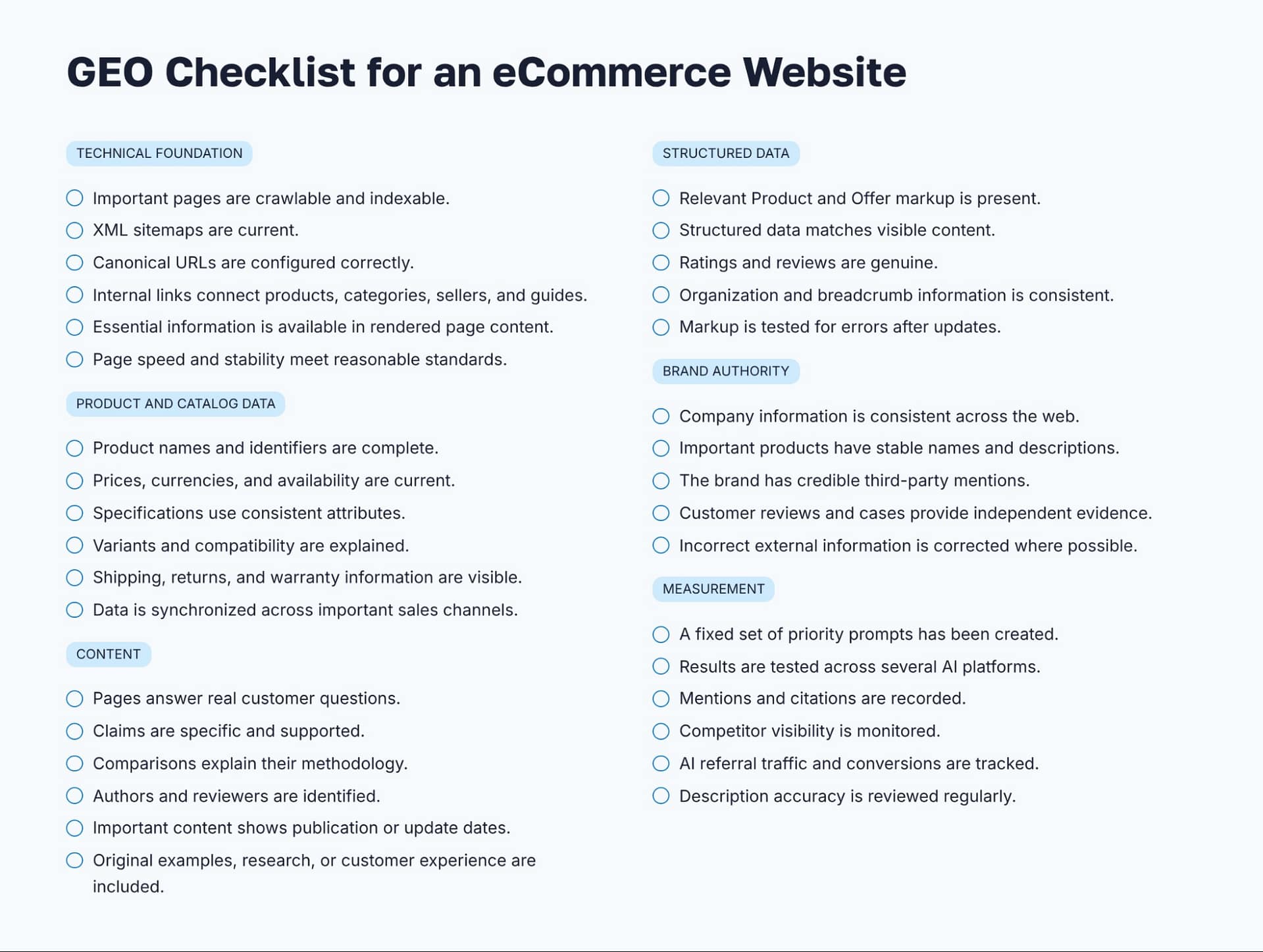
GEO Starts with a Strong eCommerce Foundation
GEO is not a shortcut for inserting a brand into AI answers. It is a way to make an eCommerce business easier to discover, understand, verify, and compare.
The websites most prepared for AI search tend to have the same qualities that benefit customers:
- Clear architecture
- Complete product information
- Consistent terminology
- Useful comparisons
- Reliable reviews
- Transparent policies
- Verifiable claims
- Independent credibility
The difference is that these elements now serve two audiences. They help people make purchasing decisions, and they give AI systems better material for answering those people’s questions.
Businesses should therefore approach GEO as an extension of product data management, technical SEO, content marketing, digital PR, and reputation management—not as an isolated content trick.
Build a GEO-Ready Store or Marketplace with CS-Cart
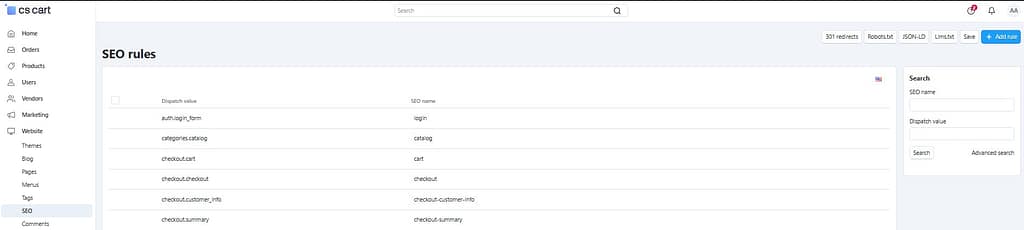
SEO rules in CS-Cart
The foundation of GEO is a commerce website where product, company, and seller information can be organized clearly and adapted as search technology evolves.
CS-Cart provides the tools to build that foundation for both single-seller online stores and multi-vendor marketplaces.
Businesses can create detailed product and category pages, manage product attributes and variations, publish editorial content, collect customer reviews, configure SEO-friendly URLs and metadata, and use structured data to help search systems interpret important information.
With CS-Cart Multi-Vendor, marketplace operators can also give sellers dedicated storefronts and connect their products, ratings, policies, and company information with the wider marketplace catalog. This is particularly important as AI-assisted shopping begins evaluating not only products, but also the merchants that sell and fulfill them.
Because CS-Cart provides source-code access, businesses can customize their store architecture, structured data, integrations, product feeds, and content workflows as their GEO strategy develops.
No eCommerce platform can guarantee inclusion in an AI-generated answer. What it can provide is the technical and data foundation required to compete for that visibility.
Explore CS-Cart and build an online store or marketplace prepared for both traditional search and AI-powered product discovery.

eCommerce expert with 10+ years of experience in marketplace management and consumer behavior. Gayane tracks the latest industry trends to provide businesses with analytical, actionable insights.