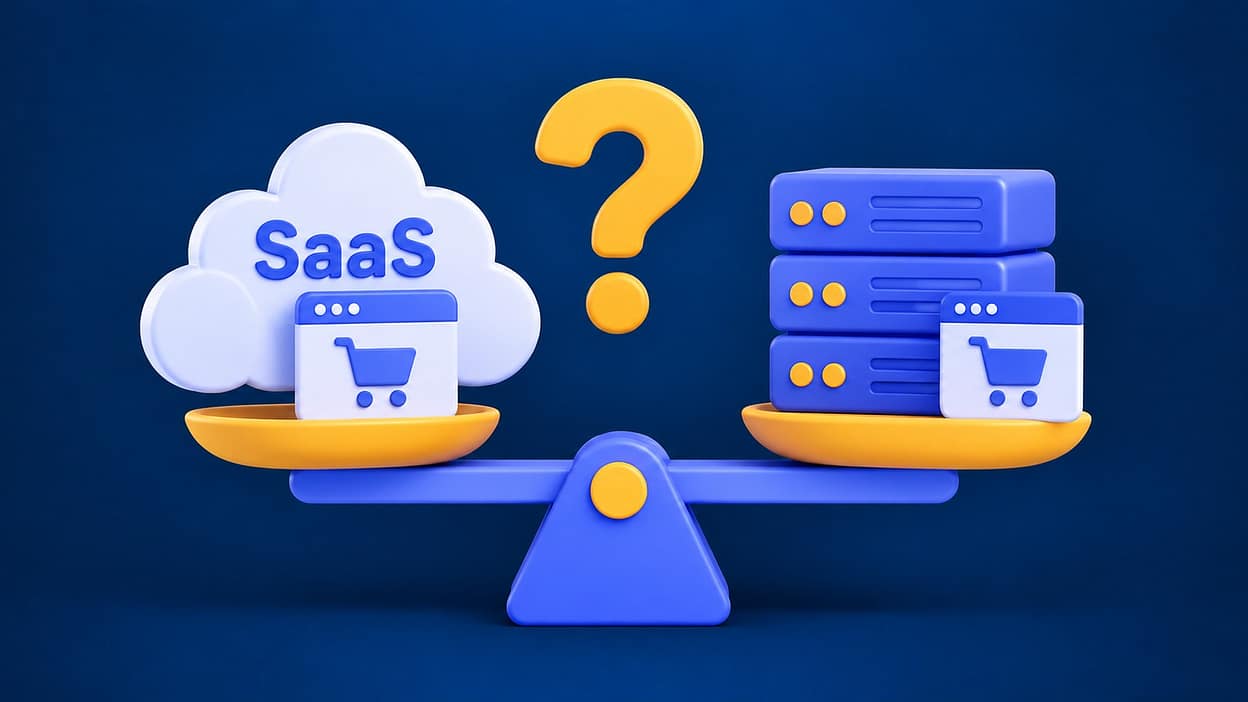
Choosing an eCommerce platform is not only a feature decision. It is also a decision about control, responsibility, and how much freedom your business will have as it grows.
With a SaaS platform, the provider hosts and maintains the software, and you pay to use it. With a self-hosted platform, your company chooses the hosting environment and takes responsibility for operating the store, either through an internal team or a hosting partner.
The simple version is that SaaS offers convenience while self-hosting offers control. The real choice is more nuanced. A fast-growing store may value automatic infrastructure management more than code access. A B2B company or marketplace may discover that standard SaaS settings cannot support its pricing, seller, or integration requirements.
This guide compares SaaS and self-hosted eCommerce across cost, customization, security, scalability, data control, maintenance, and time to market. It also provides a practical framework for deciding which model fits your business.
SaaS vs. Self-Hosted eCommerce: The Short Answer
Choose SaaS eCommerce when you want to launch quickly, have relatively standard requirements, and prefer the provider to manage hosting, platform updates, and much of the security work.
Choose self-hosted eCommerce when your competitive advantage depends on custom business logic, deep integrations, control over infrastructure and data, or the ability to change the platform beyond the limits of a vendor’s settings and interfaces.
| Factor | SaaS eCommerce | Self-hosted eCommerce |
| Launch | Usually faster | Usually requires more preparation |
| Initial cost | Typically lower | Typically higher |
| Ongoing cost | Subscription; may rise with usage, features, or sales | Hosting, maintenance, development, and upgrades |
| Infrastructure | Managed by the provider | Chosen and managed by the merchant or hosting partner |
| Platform updates | Controlled by the provider | Scheduled by the merchant |
| Customization | Limited to supported settings, apps, and interfaces | Deeper access to code, database, and server configuration, depending on the license |
| Security | Provider secures the platform; merchant still secures accounts, settings, and connected services | Merchant or partner is responsible for the full environment |
| Scaling | Provider manages capacity within plan and platform limits | Merchant controls the scaling strategy and pays for the required infrastructure |
| Data control | Governed by the provider’s contract and export tools | Greater control over storage, access, backups, and retention |
| Vendor dependence | Usually higher | Lower at platform level, but dependence may shift to developers or hosting providers |
| Best fit | Standard stores and teams with limited technical resources | Complex stores, B2B projects, marketplaces, and companies with specialized technical requirements |
What Is SaaS eCommerce?
SaaS stands for software as a service. The eCommerce provider operates the platform and makes it available through a subscription. Merchants use an administrative interface to build the storefront, manage products, accept payments, and process orders.
Shopify, BigCommerce, and Wix are familiar examples. The subscription commonly includes hosting, core software updates, security patches, and support. Merchants can extend the store through themes, apps, and integrations, but they do not control the platform’s core code or infrastructure.
Advantages of SaaS eCommerce
- Faster setup. There is no server environment to design before work on the store begins.
- Lower technical barrier. Small teams can operate a store without employing infrastructure specialists.
- Automatic platform maintenance. The provider deploys core patches and updates.
- Predictable starting cost. Subscription tiers make early budgeting relatively straightforward.
- Built-in ecosystem. Themes, apps, payment services, and documentation can reduce implementation work.
- Provider-managed capacity. The vendor handles much of the infrastructure work when traffic changes.
Disadvantages of SaaS eCommerce
- Limited backend control. Customization must fit the provider’s approved methods.
- Recurring and variable fees. The cost may increase with revenue, orders, staff accounts, locations, features, or application use.
- Platform dependence. Pricing, policies, features, and technical limits can change.
- Restricted release control. The provider decides when core changes reach the platform.
- Incomplete portability. Products and orders may be exportable, while themes, application logic, settings, and data relationships may not transfer cleanly.
- Potential ceiling for complex processes. Unusual B2B pricing, marketplace settlements, or legacy integrations may be difficult or impossible to implement.
What Is Self-Hosted eCommerce?
Self-hosted eCommerce software is installed in an environment selected by the merchant. That environment may be a company-owned server, rented infrastructure, or a managed hosting service. Self-hosted does not necessarily mean that a server sits in your office or that your employees maintain it alone.
The merchant has more control over configuration, deployment, and the timing of updates. The exact ability to inspect or change the code depends on the software license. Self-hosted software can be open source, but it can also be a commercial product that provides source-code access. These terms should not be treated as synonyms.
Examples of self-hosted eCommerce software include Magento Open Source, WooCommerce, Shopware Community Edition, and CS-Cart’s on-premises products.
Advantages of Self-Hosted eCommerce
- Deeper customization. Teams can build workflows and integrations that go beyond predefined platform settings.
- Infrastructure control. The merchant chooses hosting, server configuration, regions, backup rules, and scaling methods.
- Release control. Updates can be tested and scheduled around business operations.
- Greater data control. The company decides where data is stored and how it is backed up, retained, and accessed.
- More freedom to integrate. Direct database and backend access can support specialized systems and older internal software.
- Reduced platform lock-in. The business is less dependent on one provider’s subscription rules and product roadmap.
Disadvantages of Self-Hosted eCommerce
- More operational responsibility. Someone must monitor performance, backups, updates, and security.
- Higher initial effort. Hosting, deployment, testing, and technical ownership must be planned.
- Less predictable project cost. Custom work and integration issues can expand the budget.
- Upgrade planning. Extensions and modifications must be checked before a major platform update.
- Need for technical expertise. The company requires an internal team or a reliable implementation and hosting partner.
SaaS Is Not the Same as Cloud, and Self-Hosted Is Not Always On-Premises
Many comparisons create a false choice between a SaaS platform in the cloud and self-hosted software on a physical server inside the company. In practice, there are several models:
- SaaS: the provider controls both the platform and its hosting environment.
- Self-hosted on rented infrastructure: the merchant controls the application but uses computing resources from a cloud or hosting company.
- Managed self-hosting: the merchant controls the platform while a specialist manages servers, monitoring, backups, and sometimes updates.
- On-premises: the application runs on infrastructure directly controlled by the company.
- Platform with both delivery models: the same provider offers a managed cloud edition and a self-hosted edition for companies with different requirements.
The important question is not simply, “Is it in the cloud?” Ask who controls the application, who operates the infrastructure, and who is responsible when something fails.
SaaS vs. Self-Hosted eCommerce: Eight Key Differences
1. Time to Market
SaaS usually wins when speed is the main priority. The core environment already exists, so a merchant can focus on the catalog, design, payments, delivery, and content. A standard store may be launched without a lengthy infrastructure project.
Self-hosted software requires hosting and deployment decisions. However, the gap is smaller when the platform is a ready-made commercial product and the company uses managed hosting. The largest delays usually come from custom integrations, data preparation, and business-process changes—not from the installation itself.
Ask: Are you launching a standard storefront, or must the first version already include complex pricing, approvals, seller management, or internal integrations?
2. Customization and Business Logic
SaaS platforms can be highly configurable. Many support custom storefronts, applications, and integrations through programming interfaces. This is enough for a wide range of stores.
The limit appears when required logic sits inside a part of the platform the provider does not expose. A marketplace may need a custom commission calculation. A B2B distributor may need contract pricing that depends on customer, warehouse, payment terms, and order history. An enterprise may need to connect an older warehouse system that cannot work through a standard connector.
Self-hosted software gives a development team more ways to change backend logic. That flexibility has value only when the business has a clear need and the resources to maintain what it builds.
Ask: Which requirements cannot be handled through standard settings and documented interfaces?
3. Total Cost of Ownership
SaaS often costs less at the beginning. Self-hosted software often requires more implementation work and may involve a license, hosting, and technical support. Neither model is automatically cheaper over several years.
Use a three-year estimate rather than comparing a monthly subscription with a software license.
Three-year SaaS cost may include:
- subscription fees;
- fees linked to revenue, orders, or transactions;
- paid applications and themes;
- implementation and integration work;
- higher plan tiers required for specific features;
- additional storefronts, staff accounts, or markets;
- migration and data-export work if you leave.
Three-year self-hosted cost may include:
- software license and renewals;
- hosting, traffic, storage, and content delivery;
- implementation and integrations;
- monitoring, backups, and security;
- developer or agency support;
- extension licenses;
- testing and installing upgrades.
The right comparison is: Total cost of ownership = platform + implementation + infrastructure + extensions + integrations + maintenance + upgrades + internal labor + exit cost
Ask: How does each cost change if revenue, traffic, product count, storefronts, or sellers grow fivefold?
4. Security and Compliance
SaaS providers manage security for the platform and infrastructure. This is a significant advantage for teams that cannot provide continuous monitoring and prompt patching themselves. However, SaaS does not remove all merchant responsibility. Weak passwords, excessive staff permissions, unsafe applications, poor data practices, and misconfigured integrations can still create risk.
With self-hosted software, the merchant controls security policies and data location but is also responsible for applying them. A well-managed environment can satisfy strict requirements. A neglected server can become more vulnerable than a reputable SaaS platform.
The decision depends on the organization’s capability, contractual requirements, and the type of data it handles—not on the assumption that one model is always safer.
Ask: Which security tasks belong to the provider, hosting partner, implementation partner, and merchant? Put the answer in writing.
5. Scalability and Performance
SaaS vendors usually handle infrastructure capacity, which makes growth simpler for merchants. But scaling is still subject to plan limits, application limits, rate limits, and the provider’s architecture. A system can remain online while a particular custom process becomes a bottleneck.
Self-hosted software allows the company to choose infrastructure and tune the full environment. This can support large catalogs, regional deployment, specialized caching, and unusual traffic patterns. It also means the company must forecast demand, test performance, and pay for capacity.
The idea that SaaS scales automatically while self-hosted software cannot scale is too simplistic. Both can scale. They shift control, work, and cost to different parties.
Ask: Can the vendor demonstrate performance with your expected catalog size, order volume, integrations, and peak traffic—not only average page views?
6. Updates and Release Control
Automatic SaaS updates reduce maintenance. They also mean the merchant cannot indefinitely postpone a platform change. Most updates are routine, but a change to an interface, application, or platform policy can still affect operations.
Self-hosted merchants decide when to update. They can test a release with their modifications and schedule deployment outside peak periods. The trade-off is that delaying patches for too long can create security and compatibility problems.
Ask: How are breaking changes announced, tested, reversed, and supported?
7. Data Ownership and Portability
Both SaaS and self-hosted merchants may legally own their business data. Practical control is a different matter. Before selecting SaaS, test what the platform can export and whether the export preserves relationships between records.
Products, customers, and orders are only the beginning. A marketplace may also need seller accounts, commission rules, payout history, product approvals, messages, and dispute records. A B2B store may need company structures, roles, contract prices, credit limits, and approval histories.
Self-hosting provides more direct access to the database and files, but portability still depends on documentation and code quality. Poorly documented custom software can create a different kind of lock-in—to one developer or agency.
Ask: If the contract ended next month, what exactly could you export, in what format, and how long would you retain access?
8. Support and Internal Expertise
SaaS subscriptions commonly include platform support, but support scope varies. The provider may fix platform defects without taking responsibility for a third-party application, custom integration, theme, or business process.
Self-hosted merchants need clear ownership across software, infrastructure, and custom code. Support may come from the platform developer, a hosting company, an implementation partner, or an internal team. This can provide access to specialists who understand the complete project, but responsibilities must be coordinated.
Ask: Who owns the incident when the storefront works but an integration prevents orders from reaching the warehouse?
Which Model Fits Different Business Scenarios?
A New or Small Online Store
SaaS is usually the practical choice when the goal is to test demand, launch quickly, and use standard catalog, checkout, payment, and delivery processes. The team can validate the business before investing in technical complexity.
Self-hosting may still make sense when the founders already have technical expertise or when a nonstandard requirement is central to the business from day one.
A Growing Direct-to-Consumer Brand
The decision depends on what is driving growth. SaaS can handle substantial scale and lets the team focus on merchandising and marketing. Self-hosting becomes more attractive if rising application costs, regional requirements, custom customer experiences, or backend constraints are limiting the business.
A B2B eCommerce Project
B2B requirements often include company accounts, multiple buyers, approval workflows, contract pricing, credit terms, document exchange, and integration with enterprise resource planning systems. Some SaaS platforms support these functions, particularly on higher plans, but the exact depth must be tested.
Self-hosted software is a strong candidate when the company’s sales process cannot be simplified to fit the platform. The ability to modify business logic and connect internal systems may outweigh the additional maintenance responsibility.
An Online Marketplace
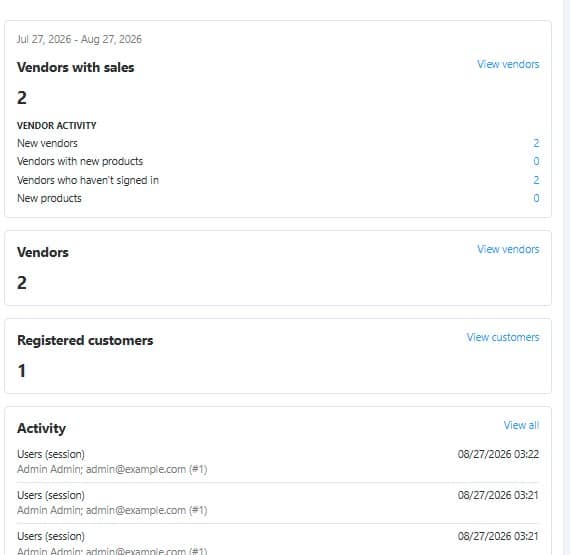
CS-Cart Multi-Vendor has a featured vendor dashboard for easy management
Marketplaces add seller onboarding, moderation, commissions, payouts, split orders, returns, and seller performance rules. A marketplace SaaS product can be effective for validating a standard concept quickly.
Self-hosting becomes more valuable when the marketplace model itself is differentiated: custom seller plans, unusual order routing, regional payment flows, specialized catalog relationships, or deep connections to logistics and financial systems.
A Regulated or Data-Sensitive Business
Do not assume that regulation automatically requires self-hosting. Some SaaS providers offer strong certifications, contractual controls, and regional data hosting. Conversely, self-hosting gives the company more direct control but also more responsibility.
Start with specific requirements for data location, access, logging, retention, audits, incident reporting, and recovery. Then test each provider against them.
When to Choose SaaS eCommerce
SaaS is likely the better fit when:
- speed matters more than deep backend control;
- the store uses common sales and fulfillment processes;
- the team has limited technical resources;
- predictable early spending is important;
- the available apps and integrations cover the roadmap;
- the company accepts the provider’s pricing and platform policies;
- export tools provide an acceptable exit path.
When to Choose Self-Hosted eCommerce
Self-hosted software is likely the better fit when:
- custom workflows are a competitive advantage;
- the business needs direct control over infrastructure or data location;
- the project depends on specialized or older internal systems;
- updates must follow a controlled testing and release process;
- marketplace or B2B rules go beyond standard platform capabilities;
- subscription, transaction, or application costs become unfavorable at scale;
- the company has an internal technical team or trusted partners;
- long-term platform independence matters more than the fastest possible launch.
Questions to Ask Before Choosing a Platform
Use the same questions for every vendor so that demonstrations and proposals remain comparable.
- Which of our requirements are standard, configurable, or custom?
- What are the technical limits for products, orders, users, sellers, and interface requests?
- Which costs change with revenue, traffic, locations, storefronts, or staff?
- What security and backup work remains our responsibility?
- Can we choose where our data is stored?
- What data and configuration can we export?
- Can another partner maintain the project?
- How are major updates tested and deployed?
- What happens to custom work after an update?
- What is the estimated three-year cost, including implementation and support?
- How would the architecture change if the business added B2B sales or a marketplace?
- What service commitments cover availability, response time, recovery, and data loss?
Can You Switch from SaaS to Self-Hosted Later?
Yes, but switching is a replatforming project, not a change of hosting plan. The company must migrate data, rebuild integrations, reproduce necessary storefront behavior, redirect web addresses, test payments and fulfillment, and train users.
Migration becomes more difficult when essential processes depend on proprietary applications or data that cannot be exported. This is why an exit plan should be part of the original platform decision.
Signs that a move from SaaS to self-hosted software may be worth evaluating include:
- important workflows cannot be implemented reliably;
- application and transaction costs grow faster than revenue;
- platform limits affect performance or operations;
- the business needs direct control over data or release timing;
- expansion into B2B, marketplaces, or new regions requires extensive workarounds;
- dependence on one provider has become a material business risk.
The reverse move can also make sense. A company may move from self-hosted software to SaaS when maintaining infrastructure and custom code consumes resources without creating a meaningful competitive advantage.
SaaS vs. Self-Hosted: There Is No Universal Winner
SaaS removes much of the technical work and is often the best way to launch a straightforward online store. Self-hosted software gives a business more control over its code, infrastructure, data, integrations, and release schedule, but that control comes with responsibility.
Choose based on the processes that make your business different, the risks you need to control, and the resources you can commit over several years. Do not decide from the platform fee alone. Compare the complete operating model and test your most difficult requirements before signing a contract.
Companies that need deeper control can use CS-Cart Multi-Vendor On-Premises on infrastructure of their choice.
If you are deciding how to deploy a store or marketplace, tell the CS-Cart team about your project. We can help you identify which model fits your requirements and where customization or infrastructure control will matter.

eCommerce expert with 10+ years of experience in marketplace management and consumer behavior. Gayane tracks the latest industry trends to provide businesses with analytical, actionable insights.