A marketplace MVP can be inexpensive to put online and expensive to operate. The difference becomes clear when the first seller uploads an incomplete catalog, a customer requests a partial refund, or someone has to reconcile commissions across several vendors.
That is why marketplace MVP cost should include the launch, the first months of operations, and the changes needed after validation. A software subscription or development quote covers only part of that budget.
This guide explains what to pay for before launch, which costs grow with transactions, and how to decide what to automate later. It also includes current software prices and a worked first-year budget.
How much does a marketplace MVP cost?
There is no single reliable price for a marketplace MVP. A founder who configures existing software is buying a different scope from a company commissioning custom payments, supplier integrations, and an original storefront.
Start by separating three numbers:
| Budget | What it includes | What it tells you |
| Launch cost | Discovery, software setup, design, integrations, testing, initial seller onboarding | What you need to open the marketplace |
| Operating cost | Software renewals, hosting, support, maintenance, acquisition, payment fees | What you need to keep it running |
| Next-stage investment | Automation, integrations, performance work, additional regions, possible migration | What changes when the business gains traction |
For a transparent estimate, use hours and scope rather than an unexplained headline range. Here are two illustrative implementation calculations:
| Approach | Assumed implementation effort | Assumed hourly rate | Calculated implementation budget (USD) |
| Configure and extend existing marketplace software | 50–150 hours | 50–100 | 2,500–15,000 |
| Build a custom marketplace MVP | 300–800 hours | 75–125 | 22,500–100,000 |
These are planning scenarios, not typical prices. They exclude software fees, legal work, seller recruitment, marketing, and ongoing operations. A complex custom project can exceed the example substantially; a founder using standard software without paid implementation can spend less.
A quote becomes meaningful only when it specifies the transaction flow, the work included, and who handles operations afterward.
Learn more from our articles:
- Total Cost of Ownership (TCO) for eCommerce Software
- Fixed Price vs. Time & Material. Which Engagement Model to Choose?
- PoC vs MVP vs Prototype for Startups and Marketplaces
What should a marketplace MVP actually prove?
A minimum viable product should test whether a defined group of buyers and sellers can complete a transaction that makes commercial sense.
For a physical-goods marketplace, that means a buyer can find a product, understand delivery terms, place an order, and receive it. The seller can manage the order, and the operator can track the commission and resolve a problem.
For a service marketplace, the essential flow may be requesting a quote, confirming availability, booking, and paying. A rental marketplace may need deposits and return-condition handling. A B2B marketplace may depend on account approval and negotiated pricing.The minimum scope follows the business model. A feature can be optional in one marketplace and essential in another.
For example, you can postpone a recommendation engine. You cannot postpone defining who refunds the buyer when an order fails.

For one of our clients we designed the user flow and the interface to sell repair services. As the result, the company now has +70 branches across the UK.
Scope One Complete Transaction
Before requesting a development estimate, write down:
- Who can sell and what approval they need.
- What buyers search for and how they decide.
- How prices, delivery, and availability are determined.
- Who receives the payment and when sellers are paid.
- How commissions, cancellations, returns, and disputes work.
- What the operator needs to see and change.
Worth reading: How to Write a Software Requirement Specification to Save Costs?
Then narrow the launch to one category, geography, or customer segment where practical. Every additional transaction type adds rules to configure, test, and support.
What You Pay For Before Launch
1. Discovery and transaction design
Discovery produces the rules that the software must follow: seller approval, order statuses, commission calculations, payout timing, refund responsibility, and administrative permissions.
Consider a cart containing products from three vendors. Do buyers make one payment or separate payments? Who calculates shipping? Can one vendor cancel without canceling the entire order? What happens to the platform commission after a partial refund?
These decisions affect the estimate even if the storefront looks simple. Resolve them before commissioning custom work.
2. Software and implementation
You can launch with hosted marketplace software, a self-hosted marketplace platform, an ecommerce platform with extensions, or a custom application.
The advertised price represents a different package in each case. A hosted subscription may include infrastructure maintenance. A self-hosted license requires a hosting arrangement. An extension may rely on a separate ecommerce subscription and other paid plugins.
Compare the cost of your required workflow, including the plan that actually supports it.
Current examples:
| Product and plan | Published price | Budgeting implication |
| Sharetribe Build | $39/month, billed monthly | For building and testing before launch; it is not the live-business plan |
| Sharetribe Live | $199/month billed yearly, or $259/month billed monthly | $2,388 annual commitment or $3,108 over 12 monthly payments; usage above included credits costs extra |
| CS-Cart Multi-Vendor Standard | $725/year | Self-hosted software; approximately $61/month is an annual-price equivalent |
| CS-Cart Multi-Vendor Plus | $1,449/year, or $3,590 for a lifetime license | Compare both feature requirements and renewal terms |
Sources: Sharetribe pricing and CS-Cart Multi-Vendor pricing.
Learn more: Sharetribe vs. CS-Cart: Which Marketplace Platform Best Suits Your Business Needs?
These products are not identical packages. Hosting, customization, payment processing, and support coverage require separate comparison.
An annual price displayed as a monthly equivalent does not mean you can purchase one month at that rate. Keep the upfront cash commitment in your launch budget.
3. Storefront design and content
A template can reduce design work, but somebody still needs to configure navigation, categories, product pages, seller information, checkout messages, and policy pages.
The expensive part is often making the marketplace understandable. Buyers need to know whether products arrive together, whether vendors have different return rules, and who answers questions.
For an MVP, prioritize a usable mobile storefront and clear transaction information. An elaborate homepage contributes little if delivery costs appear too late or sellers cannot provide consistent product data.
Read more: Best CS-Cart Themes and Templates for Your Online Store
4. Payment and fulfillment setup
Payment integration includes more than a checkout button. The work can involve seller onboarding, commission collection, payout status, refunds, failed notifications, and reconciliation.
Physical products also need shipping rules and fulfillment ownership. A marketplace handling delivery centrally has a different scope from one where each vendor ships independently.
Ask the implementer to demonstrate a failed payment, a duplicate payment notification, a canceled order, and a refund. A successful test purchase does not verify these scenarios.
5. Catalog preparation and seller onboarding
Vendor accounts do not automatically produce useful supply. Sellers may need help with product files, images, attributes, stock information, pricing, and delivery settings.


B2Brics is a marketplace built on CS-Cart. They use a detailed onboarding guide to attract and onboard quality vendors. Over 100 suppliers, 300+ importers, and 30+ partners joined the platform in two months.
Calculate this work explicitly. If onboarding takes two hours per seller and you recruit 30 sellers, that is 60 hours before follow-up questions. At an assumed labor cost of $25 per hour, the initial work costs $1,500.
This is an illustrative calculation. Your onboarding effort depends on seller readiness and catalog quality, not simply the number of accounts.
6. Policies, testing, and launch preparation
Budget for appropriate seller agreements, buyer policies, privacy documentation, and advice relevant to your operating countries and transaction model.
Also allocate time for permission testing, email delivery, analytics setup, backups, and recovery checks. With a self-hosted or custom application, identify who owns each technical task. With hosted software, confirm which responsibilities remain yours.
The deliverable should be a marketplace you can operate, with access credentials, documentation, and a defined support route.
What you pay for after launch
Software, hosting, and maintenance
Recurring technical costs can include subscriptions, license renewals, hosting, storage, transactional email, monitoring, backups, and paid extensions.
Avoid counting the same service twice. If your SaaS subscription includes database hosting, do not add a separate database bill unless your custom architecture needs one.
Maintenance also requires attention to integrations and customizations. A change in a payment API or shipping service can create work even when you have not requested a new feature.
Ask for a maintenance scope covering updates, compatibility checks, incident handling, and the treatment of custom code. A generic percentage of development cost is less useful than knowing what the agreement includes.
Customer and seller support
Marketplace support serves at least two groups. Buyers ask about orders; sellers ask about listings, commissions, inventory, and payouts. Some cases involve both.
Support software is only one expense. Labor is the larger question to model.
Suppose 1,000 monthly orders generate support contacts on 10% of orders. If each takes 15 minutes, that is 25 hours. At an assumed $20 per hour, order support costs $500, before general seller assistance.
These are example assumptions, not support benchmarks. Replace them with your observed contact rate and handling time.
Seller recruitment and buyer acquisition
Launching the website does not create marketplace liquidity: buyers still need relevant supply, and sellers need credible demand.
Your acquisition budget may cover founder outreach, partnerships, paid advertising, content, SEO, seller incentives, and help preparing listings.
Track the result beyond signups. A seller who never publishes an available product contributes little to the buying experience. A buyer who registers but cannot find a suitable item does not validate the transaction model.
Useful measures include cost per activated seller, cost per first purchasing buyer, search-to-purchase conversion, and repeat purchase rate.
Read more: Marketplace Unit Economics: How to Calculate LTV for eCommerce
Payment processing and seller payouts
Payment fees grow with payment volume and transaction count. They should be modeled separately from the platform subscription.
Stripe’s published US standard online card rate is 2.9% + $0.30 per successful domestic card transaction. International cards, currency conversion, and other payment methods can have different charges. See Stripe pricing.
For an illustrative $50 order:
- Processing fee: $50 × 2.9% + $0.30 = $1.75.
- Marketplace commission at an assumed 10%: $5.00.
- Commission remaining if the marketplace absorbs processing: $3.25, before other expenses.
Stripe Connect has separate pricing arrangements. Under its “you handle pricing” model, published charges include $2 per monthly active connected account and 0.25% + $0.25 per payout. Under “Stripe handles pricing,” those additional account and payout fees are not charged to the platform. Other capabilities can carry additional fees. See Stripe Connect pricing.
Do not apply one fee schedule to every marketplace. Identify the country, payment method, integration model, payout frequency, and party responsible for each charge.
Refunds, disputes, and cash reserves
A refunded sale can still leave costs behind. Stripe states that, under standard pricing, the original processing, Connect, and currency conversion fees are not returned when a transaction is refunded. See its refund pricing explanation.
You also need to budget for dispute handling, possible losses, and the time spent obtaining information from sellers.
Keep operating cash distinct from seller funds. Gross merchandise value, or GMV, is the value of transactions through the marketplace; it is not the platform’s revenue. Money owed to vendors cannot fund your development roadmap.
A worked first-year marketplace MVP budget
Consider a small physical-goods marketplace using existing software, a standard theme, one country, and limited custom work.
The following is a hypothetical planning model, not a CS-Cart implementation quote. It assumes founder-led operations with paid part-time assistance. It excludes a full-time founder salary, taxes, inventory purchases, shipping subsidies, additional Connect charges, and major custom integrations.
One-time launch expenses
| Item | Assumed budget |
| Discovery and transaction rules | $1,000 |
| Configuration and limited customization | $3,000 |
| Design and launch content | $2,500 |
| Initial seller onboarding and catalog preparation | $1,500 |
| Professional policy and accounting setup | $2,000 |
| Testing and launch preparation | $2,000 |
| Total one-time launch expenses | $12,000 |
Recurring expenses
| Item | Monthly allowance | Annual cost |
| Software and hosting combined | $250 | $3,000 |
| Maintenance | $300 | $3,600 |
| Support and marketplace administration | $800 | $9,600 |
| Seller recruitment and onboarding | $750 | $9,000 |
| Buyer acquisition and content | $800 | $9,600 |
| Total fixed and planned recurring expenses | $2,900 | $34,800 |
The software allowance is a placeholder. Replace it with your selected product, billing schedule, hosting, and extensions. Allocate each invoice once.
Assume first-year GMV of $120,000 and an average order value of $50:
- Annual orders: $120,000 ÷ $50 = 2,400.
- Processing at the US card rate above: $120,000 × 2.9% + 2,400 × $0.30 = $4,200.
- Planned first-year expenses: $12,000 + $34,800 + $4,200 = $51,000.
- An illustrative 10% contingency: $5,100.
- Funding allowance before revenue offsets: $56,100.
The contingency is a chosen planning buffer, not an industry standard. Seller settlement obligations or processor reserve requirements may require additional cash.
At a 10% commission, $120,000 in GMV produces $12,000 in gross commission revenue. That does not cover this model’s annual spending. If the marketplace pays the modeled processing fees, $7,800 remains before operating expenses.
The lesson is practical: a $12,000 launch quote and a $56,100 first-year funding allowance can describe the same project.
Check the break-even assumptions
Using the same $50 order, a $5 commission, and a $1.75 processing fee, contribution before other order-related costs is $3.25.
At $2,900 in monthly recurring expenses:
$2,900 ÷ $3.25 ≈ 893 orders per month.
That represents roughly $44,650 in monthly GMV. It does not recover launch spending or include extra payout fees, refunds, taxes, or growth-related hiring. Support and acquisition expenses may also change at that volume.
Use this calculation as a sensitivity check. Test a lower average order value, a different commission, higher support demand, and slower buyer acquisition before treating the budget as viable.
Which Costs Appear Later—And Why?
Manual work becomes a staffing expense
Manual seller approval or catalog cleanup can be sensible during validation. The cost becomes a problem when the task repeats faster than your team can handle it.
For example, ten minutes of administration across 500 weekly orders requires more than 83 hours. At an assumed $20 per hour, that is approximately $1,667 per week.
An automation project costing $6,000 would have a simple payback of about 3.6 weeks if it eliminated all that work. In practice, account for partial savings, implementation time, maintenance, and exceptions that still need a person.
Measure repeated work before automating it. The most valuable next feature may be an import validator or reconciliation report rather than another storefront enhancement.
Integrations move from optional to necessary
Early sellers may update inventory manually. Larger suppliers may require an ERP, warehouse, or product-information integration.
The budget includes data mapping, error handling, monitoring, and recovery from failed updates—not just connecting an API endpoint.
Before adding an integration, quantify the consequence of staying manual: overselling, listing delays, staff time, or missed supplier participation. That gives the investment a business case.
Performance work follows the workload
Infrastructure needs depend on catalog size, images, searches, imports, background jobs, and concurrency. Registered user count alone is an incomplete guide.
Track slow operations and failed jobs, then address the bottleneck. A larger server may help, but it will not necessarily fix an inefficient import or an excessive API polling schedule.
Hosted plans can also introduce usage-based expenses. Include those limits in your growth model.
Expansion adds new operating rules
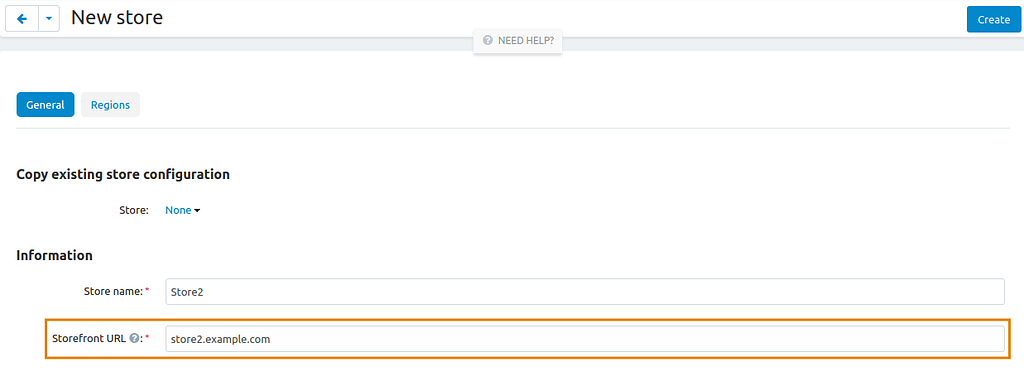
CS-Cart has a multiple storefront functionality starting from the Ultimate version
Another country can mean additional currencies, payment arrangements, delivery rules, languages, customer support, and professional advice. Another category can require new attributes, moderation, or return procedures.
Treat expansion as a scoped project. Existing storefront templates do not make every operational requirement reusable.
Migration creates a second implementation budget
A move to another platform may involve product and account migration, order history, redirects, integrations, seller training, and a period of running systems in parallel.
Some data transfers easily; other elements need a new process. Check export capabilities and payment-provider restrictions before assuming everything can move unchanged.
You do not need to purchase every future feature today. You do need to know whether the platform can support your next likely workflow and what extending it would require.
What can you postpone without weakening the MVP?
The safest savings reduce scope while preserving a complete, manageable transaction.
| Requirement | Sensible MVP approach | Signal to invest more |
| Seller onboarding | Assisted setup for a small selected group | Onboarding delays prevent useful sellers from joining |
| Catalog management | Structured imports and manual quality checks | Repeated errors or cleanup consume substantial time |
| Customer service | A shared inbox with clear ownership | Response delays affect completed orders and retention |
| Analytics | Transaction, activation, and retention reports | Decisions require segmentation the existing reports cannot provide |
| Mobile experience | A usable responsive website | Evidence shows an app would improve a core recurring task |
| Integrations | Manual work where volume permits | Labor cost or stock errors justify automation |
| Geographic reach | One focused launch market | Existing demand supports the cost of expansion |
Postponing automation is different from postponing the underlying rule. You can handle disputes manually, but you still need a policy, records, and an accountable decision-maker.
How To Compare Marketplace Software By Total Cost
Ask each vendor or implementation partner to price the same operational scenario:
A buyer orders from two sellers. One fulfills the order. The other cancels. The marketplace refunds the canceled portion, corrects the commission, and reconciles what each seller is owed.
Then ask:
- Which steps are included in the proposed plan?
- Which need an extension, custom code, or manual work?
- Who is responsible for payment fees and financial losses?
- What support and updates are included, and for how long?
- What changes at higher order, catalog, or API volume?
- Can our likely next integration be implemented on this platform?
- What data and documentation will we receive if we leave?
The cheapest subscription can become expensive if routine operations require repeated staff intervention. A more expensive plan can also be wasteful if its advanced features do not address your actual workflow.
Where CS-Cart Fits A Marketplace MVP Budget
For a product marketplace, CS-Cart Multi-Vendor offers an alternative to building the underlying ecommerce and vendor administration system from scratch. Its marketplace features cover areas such as vendor management, catalogs, orders, and monetization.
The budget still needs implementation, hosting, payment processing, seller onboarding, maintenance, and acquisition. Self-hosting also means assigning responsibility for the infrastructure.
Choose the edition around the operating model. The plan comparison places features such as a shared vendor catalog and category-based commissions in higher plans than Standard. Multiple storefronts and warehouse capabilities also require the appropriate edition.
CS-Cart does not charge a platform transaction fee. Payment providers can still charge processing and payout fees, and lifetime licensing does not eliminate ongoing hosting, maintenance, or paid services.
If you are comparing approaches for growth, see CS-Cart vs Arcadier: Which Marketplace Platform Fits Your Growth Plan?. For an MVP decision, test your essential order and vendor workflows in a marketplace demo before building the budget around a plan name.
Frequently Asked Questions
What is the cheapest way to validate a marketplace idea?
You can begin by recruiting a small group of sellers and manually helping buyers find suitable supply. This can test demand before a full software implementation. To validate online checkout and fulfillment, move to a narrowly scoped live marketplace with clear payment and support responsibilities.
Can I launch a marketplace MVP for under $5,000?
It is possible when existing software fits, you do much of the work yourself, and customization is limited. Treat that as a launch constraint. It does not automatically cover operating expenses, acquisition, professional advice, or the value of your own time.
Does no-code mean there are no development costs?
No-code can remove the need to develop supported workflows. Configuration, content, testing, and onboarding still take work. Requirements outside the supported workflow may need custom development, an integration, or a manual process.
How much should I budget for marketplace maintenance?
Estimate maintenance from the responsibilities involved: hosting, updates, custom code, integrations, monitoring, and incident response. Request a defined service scope. A percentage of the original build cost alone does not establish what support you will receive.
Are marketplace transaction fees and payment processing fees the same?
No. A software vendor may charge a fee tied to transactions or GMV. A payment provider charges for processing payments and may charge separately for payouts and other services. A platform with no transaction fee can still incur payment-provider fees.
When should I invest beyond the MVP?
Invest when transaction data identifies a repeatable constraint: seller activation is too slow, stock errors cause cancellations, support costs rise, or buyers repeatedly fail at the same step. Set a measurable target for the improvement and compare its cost with the expected benefit.

eCommerce expert with 10+ years of experience in marketplace management and consumer behavior. Gayane tracks the latest industry trends to provide businesses with analytical, actionable insights.