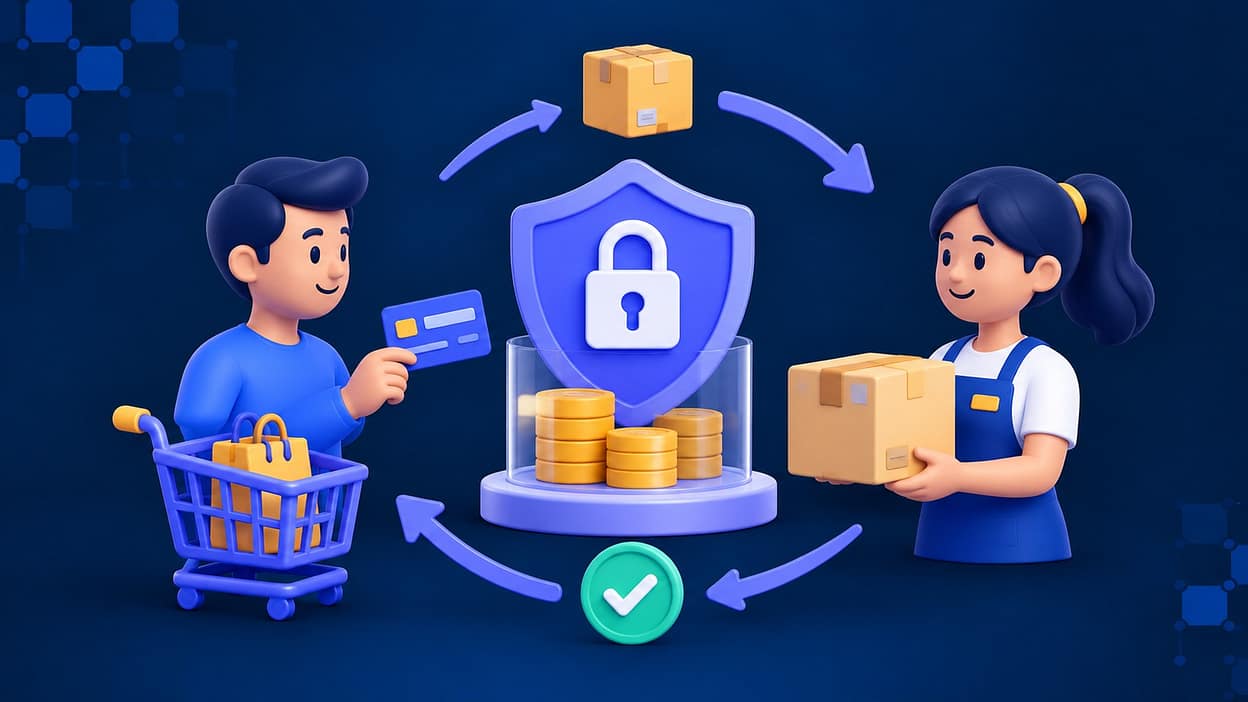
An unfamiliar buyer does not want to pay before receiving an order. An unfamiliar seller does not want to ship before knowing the buyer has paid. The marketplace stands between them—and its job is to make the transaction possible without asking either side to rely on blind trust.
Escrow can help solve this problem. In a typical escrow transaction, a third party safeguards the buyer’s funds until predefined conditions have been met. The seller can see that the money has been committed, while the buyer knows it will not be released immediately.
However, adding a payment hold does not automatically create a trustworthy marketplace. The platform still needs to verify participants, define what counts as successful fulfillment, collect evidence, handle disputes, process refunds, and explain the rules clearly. It must also distinguish genuine escrow from delayed payouts and other payment mechanisms that may look similar but have different legal and operational implications.
This guide explains how marketplace escrow works, when it makes sense, and how to place it within a broader trust system.
Key Takeaways
- Escrow protects a transaction by safeguarding funds until agreed conditions are met.
- Escrow, delayed payouts, payment authorization, security deposits, and split payments solve different problems.
- A marketplace should define its release, refund, and dispute rules before selecting a payment provider.
- Escrow is most useful when transactions are high-value, customized, cross-border, or completed long after payment.
- Payment protection cannot replace seller verification, content moderation, delivery evidence, reviews, or clear policies.
- The actual movement and safeguarding of money should be handled by a suitable licensed provider for the markets in which the marketplace operates.
What Is Marketplace Escrow?
Marketplace escrow is an arrangement in which funds are held by a neutral or appropriately authorized party until the buyer and seller meet predetermined transaction conditions.
A basic escrow flow looks like this:
- The buyer and seller agree to the transaction terms.
- The buyer submits payment to the escrow provider.
- The provider confirms that the funds have been secured.
- The seller delivers the product or performs the service.
- The buyer accepts the result, or another defined release condition is met.
The provider releases the seller’s funds, usually after deducting the marketplace commission.
If the seller does not fulfill the order, the funds may be returned to the buyer. If the parties disagree, the transaction moves into a dispute process governed by the marketplace’s policies and the provider’s capabilities.
Escrow.com describes this general model as an agreement followed by buyer payment, seller delivery, buyer approval, and payment release. The exact process, responsibilities, and legal status nevertheless vary by provider and jurisdiction.
Escrow Is Not the Same as Holding a Payout
The word escrow is often used loosely in marketplace content. A platform may describe any delay between the buyer’s payment and the seller’s payout as escrow. Technically and legally, that may be incorrect.
Stripe states explicitly that it does not provide escrow services or support escrow accounts. Its manual payout functionality lets a platform control payout timing, subject to country-specific holding periods, but delayed access to funds is not automatically escrow.
Marketplace founders therefore need to separate several related mechanisms:
| Mechanism | What it does | Typical use |
| Escrow | Safeguards funds until contractual conditions are satisfied | High-value goods, custom work, cross-border trade |
| Delayed payout | Postpones when the seller receives funds | Delivery windows, refund risk, platform quality controls |
| Split payment | Divides one customer payment among sellers and the marketplace | Multi-vendor orders and automatic commission collection |
| Payment authorization | Reserves an amount before it is captured | Bookings, inventory confirmation, short fulfillment windows |
| Security deposit | Secures an additional amount against damage or loss | Rentals and asset-sharing marketplaces |
| Marketplace wallet | Records or stores balances inside a payment ecosystem | Refund credits, seller balances, staged transactions |
These mechanisms can be combined. A rental marketplace, for example, may collect the booking price, secure a damage deposit, deduct its commission, and delay the provider’s payout until the rental ends. That is a sophisticated payment flow, but whether it constitutes escrow depends on how the funds are legally held and who is authorized to control them.

CSiRentals on CS-Cart Multi-Vendor implemented online rental marketplace with the smart calendar feature
The distinction matters because payment terminology affects customer expectations, contracts, licensing, accounting, and marketplace liability. Before promoting an “escrow” feature, the operator should confirm the description with its payment provider and legal adviser.
How Escrow Builds Marketplace Trust
Escrow reduces a particular problem: counterparty risk. It gives each participant evidence that the other side has made a meaningful commitment.
Protection for buyers
Without payment protection, a buyer may have to send money directly to an unknown seller and hope the order arrives as described. Escrow can reduce this risk by preventing immediate release of the funds.
Depending on the transaction rules, buyers may receive:
- confirmation that their payment is being safeguarded;
- time to receive or inspect the purchase;
- a way to report non-delivery or material discrepancies;
- a defined route to a full or partial refund.
This can be particularly valuable for expensive, custom-made, used, or cross-border products, where a failed transaction is difficult to reverse.
Protection for sellers
Sellers also face risk. A buyer may place a large custom order and later fail to pay, or a service provider may complete weeks of work without knowing whether the client has sufficient funds.
Escrow can show the seller that the buyer has already committed the agreed amount. If the seller meets the documented conditions, the payout can be released according to the transaction rules rather than depending on the buyer’s willingness to pay afterward.
Read more: 10 Ways to Build Trust in eCommerce
Control for the marketplace
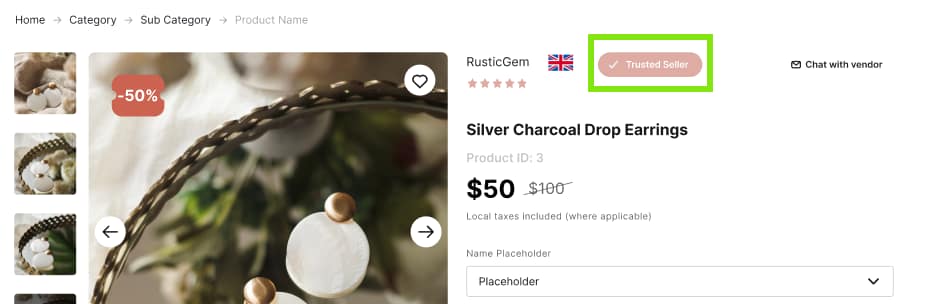
One of our clients implemented vendor verification badge to even more boost trust on their platform.
A defined payment flow helps the marketplace enforce consistent rules. It can connect payment release to order status, collect its commission, record what happened, and pause a disputed transaction without necessarily stopping every payment to a seller.
This control also creates responsibility. If the marketplace promises buyer protection, it must be able to explain what is protected, what evidence it accepts, how long decisions take, and who makes the final decision.
Learn more from: Zero Trust Security Model: Principles, Architecture, and Implementation
What Escrow Cannot Fix
Escrow protects money during a transaction. It does not establish that every participant, listing, or product is trustworthy.
It cannot by itself:
- prove that a seller is a legitimate person or business;
- identify counterfeit or prohibited products;
- guarantee that product photos and descriptions are accurate;
- prevent account takeover;
- establish an objective standard for subjective service quality;
- stop users from moving a transaction outside the platform;
- create fair dispute decisions without evidence and policies;
- ensure that reviews are genuine.
For this reason, escrow should be treated as one layer in a marketplace trust system—not the entire system.
When Does a Marketplace Need Escrow?
The decision should begin with risk rather than with a feature checklist. Sharetribe recommends evaluating users’ perceived risks before choosing trust mechanisms. This is useful because a low-value retail marketplace and a platform for industrial equipment may need very different protections.
Escrow is worth considering when one or more of the following conditions apply.
There is a long gap between payment and fulfillment
A consumer buying an in-stock household item may receive it in two days. A client commissioning a custom machine, website, or wedding service may wait weeks or months. The longer the interval, the greater the concern about paying in advance and the greater the seller’s risk of beginning work without committed funds.
Transactions have a high value
Users are less willing to rely on an unknown counterparty as the amount at risk increases. Vehicles, specialist equipment, jewelry, collectibles, wholesale orders, and business assets may all justify stronger payment protection.
The result must be inspected or approved
Custom products and professional services rarely have a simple “shipped” state. The buyer may need to inspect an item, approve a milestone, confirm a file transfer, or accept completed work. Escrow can connect payout to that approval process, provided that acceptance criteria are clear.
The marketplace supports rentals
Rental marketplaces must protect both the rental fee and the underlying asset. A payment flow may need to cover deposits, damage reports, extensions, cancellations, and the return condition.
Buyers and sellers operate across borders
Cross-border transactions involve longer delivery times, currency conversion, unfamiliar counterparties, and more complicated refunds. Escrow can reduce some counterparty risk, although it does not remove customs, sanctions, tax, or local payment-regulation requirements.
The marketplace sells used or unique goods
The condition of a used item can be disputed more easily than the condition of a standardized new product. Marketplaces for watches, musical instruments, art, refurbished electronics, collectibles or personalized items may combine payment protection with authentication and inspection.
When Escrow May Be Unnecessary
More protection is not always better. Every additional stage introduces cost, complexity, customer-support work, and slower access to seller revenue.
Formal escrow may be unnecessary when:
- order values are low;
- fulfillment is immediate or automatic;
- the marketplace sells standardized digital products;
- established retailers already carry the fulfillment risk;
- card protections or another provider-managed mechanism cover the main risk;
- sellers need rapid cash flow and the transaction risk is small;
- the provider’s fees and operational requirements outweigh the likely loss reduction.
A marketplace can also apply stronger controls selectively. New sellers, high-risk categories, unusually large orders, or transactions with changed bank details may receive longer payout delays, while proven sellers follow a faster flow. Any differentiated policy should be documented and applied consistently.
Design the Release Logic Before Choosing a Provider
An escrow or delayed-payout integration cannot compensate for an undefined business process. Marketplace operators should first describe the complete transaction as a set of states, triggers, deadlines, and exceptions.
Define successful fulfillment
What event shows that the seller has completed the transaction?
Depending on the marketplace, it could be:
- carrier-confirmed delivery;
- buyer confirmation;
- completion of a booking;
- return of a rented asset;
- approval of a project milestone;
- transfer of a digital asset;
- inspection by an independent expert.
Avoid relying on a vague status such as “completed” without documenting who sets it and what evidence supports it.
Learn more from: Data Marketplaces: How to Build a Data Exchange Business?
Decide when funds are released
Buyer approval gives the customer control, but it can create a problem when the buyer forgets or refuses to respond. Automatic release is more predictable for sellers, but the buyer needs a reasonable inspection window.
A common approach combines both:
- The buyer may approve the order immediately.
- The buyer has a fixed period in which to open a dispute.
If no dispute is opened, the system releases the payout automatically. If a dispute is opened, release pauses until a decision is made. The marketplace should also define time zones, business days, extensions, notification schedules, and what happens when required data is missing.
Plan for partial outcomes
Real transactions do not always end with a full payout or full refund. A multi-vendor order may contain products from several sellers. One item may be returned while the rest are accepted. A project may have completed and incomplete milestones. A rental may require a partial deduction for damage.
The payment system should therefore be evaluated for:
- partial capture and release;
- partial refunds;
- commission reversal;
- tax and shipping adjustments;
- seller-specific disputes within one order;
- multiple currencies;
- negative seller balances and chargeback recovery.
Establish the dispute process
A dispute policy should answer four questions:
- Who may open a dispute? The buyer, seller, administrator, or all three?
- When can it be opened? Before delivery, during inspection, or after release?
- What evidence is accepted? Tracking, photographs, messages, inspection reports, or work files?
- Who decides the result? The marketplace, payment provider, arbitrator, or another party?
The policy must also explain deadlines, appeals, prohibited conduct, and possible outcomes. Without these rules, holding funds merely postpones the conflict.
The Marketplace Trust Stack
A reliable marketplace combines financial safeguards with controls before, during, and after each transaction.
1. Identity and business verification
Verification can include email and phone confirmation, identity checks, business-registration data, beneficial-owner information, bank-account verification, licenses, or insurance. Requirements should reflect the risk of the category and applicable KYC or KYB obligations.
2. Seller approval and monitoring
Initial verification is only a snapshot. Marketplaces should monitor complaints, cancellations, refund rates, fulfillment times, unusual account changes, and prohibited behavior. Seller statuses should have clear consequences, and vendors should be told why their access has been restricted when appropriate.
3. Listing standards and moderation
Accurate descriptions, real images, category-specific fields, prohibited-product rules, and moderation reduce the chance of a dispute before payment occurs. High-risk categories may require documents or manual approval.
4. Transparent transaction terms
Buyers and sellers should see the price, marketplace fee, taxes, delivery terms, cancellation rules, inspection window, payout timing, and refund conditions before they commit. Hiding important terms behind a general policy page weakens trust.
5. Secure marketplace payments
Keeping payment on the platform creates consistent records and gives users access to platform protections. On-platform payments can also automate commissions, refunds, and seller reconciliation. Security controls should include appropriate authentication, tokenized payment data, and fraud monitoring through the selected provider.
6. Escrow or controlled payout timing
The marketplace should apply the mechanism that matches the actual risk and describe it accurately. A licensed escrow service may be appropriate for some transactions; provider-supported delayed payouts may be sufficient for others.
7. Fulfillment evidence
Tracking numbers, delivery scans, booking records, milestone approvals, and on-platform messages help establish what happened. The evidence model should be designed together with the release rules.
8. Dispute and refund management
Users need an accessible process, clear deadlines, status updates, and consistent decisions. Administrators need a complete transaction record rather than disconnected emails and screenshots.
9. Reputation systems
Reviews help users learn from previous transactions and give sellers an incentive to maintain quality. However, reputation systems also need controls against manipulation, retaliation, and reviews from people who never completed a transaction. Research on the design of online marketplaces describes both the value of reviews and the strategic behavior they can create.
10. Account and fraud protection
Two-factor authentication, login monitoring, bank-detail change controls, velocity limits, device signals, and manual review can help identify account takeover and transaction fraud. Trust must protect the seller’s account as well as the buyer’s order.
You may also interested in reading: CS-Cart Anti-Spam Guide: Built-In Spam Protection and Recommended Add-ons
How to Choose an Escrow or Marketplace Payment Provider
Do not begin and end with the question, “Does it support escrow?” Compare the provider with the actual transaction design.
Ask potential providers about:
- countries, currencies, and marketplace models supported;
- licenses and the legal structure used to safeguard funds;
- buyer and seller onboarding requirements;
- KYC, KYB, sanctions, and beneficial-owner checks;
- maximum holding or delayed-payout periods;
- supported release triggers;
- partial and milestone-based releases;
- multi-seller transactions and commission splitting;
- refunds after a payout has been released;
- chargeback responsibility and negative balances;
- dispute-management responsibilities;
- security deposits and preauthorization;
- reconciliation, reporting, and webhook events;
- API quality and implementation support;
- transaction, payout, currency-conversion, and dispute fees.
Coverage may also depend on where the marketplace company is registered, where its sellers are located, and what they sell. A provider suitable for a domestic product marketplace may not support a cross-border service platform.
Most importantly, the marketplace should not collect customer funds into an ordinary operating account and assume that internal accounting turns the arrangement into escrow. The payment and legal structure should be reviewed by qualified specialists in the relevant jurisdictions.
Building a Trust Workflow with CS-Cart Multi-Vendor
CS-Cart Multi-Vendor provides the commerce and vendor-management layer around a marketplace transaction. The actual safeguarding and regulated movement of funds should be performed through an appropriate payment or escrow provider.
Within the marketplace, operators can build trust through connected operational controls:
- vendor applications and administrator approval;
- vendor statuses and notifications;
- individual vendor storefronts;
- product and vendor moderation;
- ratings and reviews;
- marketplace commissions and vendor accounting;
- order statuses and administrator oversight;
- payment integrations;
- communication of shipping, return, and marketplace policies;
- add-ons or custom development for specialized transaction flows.
For example, the CS-Cart Stripe Connect add-on can distribute order revenue among vendors and the marketplace according to configured commissions and unpaid payouts. This is useful for multi-vendor settlement, but it should not be described as escrow: the payment provider’s rules determine how funds are processed and when they become available.
A marketplace that needs a specialized approval, milestone, rental, or inspection process can map those events to CS-Cart order statuses and integrate them with the selected provider’s API. The exact implementation depends on the provider, edition, countries, and transaction model, so it should be validated during solution design.
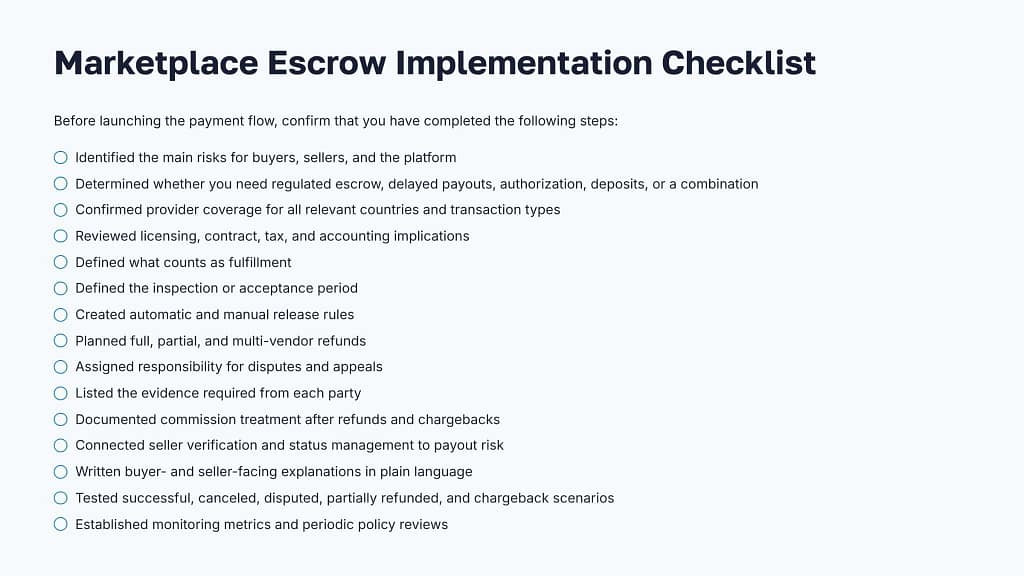
Trust Must Cover the Whole Transaction
Escrow can remove a major barrier between strangers: the buyer does not need to release money directly to an unknown seller, and the seller does not need to begin fulfillment without evidence that funds have been committed.
But trust is created by the complete transaction design. Verification reduces the chance that a bad actor enters the marketplace. Moderation improves listing quality. Clear terms establish expectations. Payment controls protect funds. Fulfillment evidence makes disputes easier to resolve. Reviews help future users make better decisions.
The right question is therefore not simply, “Should our marketplace offer escrow?” It is: “Where can this transaction fail, and what combination of controls will protect each participant without making the process unnecessarily slow or expensive?”
CS-Cart Multi-Vendor gives marketplace operators the vendor, catalog, order, commission, moderation, and integration infrastructure needed to build that wider trust system. Combined with a suitable payment provider and clearly designed business rules, it can support a transparent marketplace experience from seller onboarding to final settlement.

eCommerce expert with 10+ years of experience in marketplace management and consumer behavior. Gayane tracks the latest industry trends to provide businesses with analytical, actionable insights.