Starting a multi-vendor marketplace without a clear budget is like going on a space journey without knowing how much fuel you have. You might start excited, but soon you’ll worry as fuel runs out way before you finish your journey. This shows why it’s so important to plan your resources carefully when going on a long trip—building a multi-vendor marketplace platform.
Developing a multi-vendor marketplace with just a rough idea of costs can seem easy at first. Early money might cover basic things like building the site and getting the word out. But, just like surprises on a journey that cost extra money, unexpected problems with your multi-vendor marketplace can eat up your budget fast.
This article will come in handy if you’ve already decided to develop your multi-vendor marketplace and are currently planning your budget. We’ll talk about expenditures and give you a fresh breakdown of Multi-Vendor marketplace development costs in 2026.
Ensuring Legal Compliance Before Starting Marketplace Development
Developing a multi-vendor eCommerce marketplace requires careful planning and integration of key functionalities to ensure legal compliance. Here’s how to address these needs and the risks of overlooking them, with a focus on keeping your multi-vendor marketplace platform compliant and competitive:
1. Payment Gateway Integration
Why it matters: Decide how customers will pay, how sellers will receive funds, and which party handles refunds and disputes. Confirm the payment provider’s marketplace capabilities and determine which PCI DSS requirements apply to your implementation. The future-dated requirements in PCI DSS v4.0.1 took effect on March 31, 2025.
Budget for: Payment integration, payout workflows, testing, fraud controls, and any security work required by your payment setup.
2. Tax Calculation and Management System
Why important: Your multi-vendor marketplace platform needs an automatic system for calculating taxes. This system should handle different tax rates for various products and regions correctly.
What if you don’t comply: Getting taxes wrong can lead to fines and disputes with tax authorities. It can also upset customers charged the wrong amount on your multi-vendor eCommerce marketplace.
3. Data Protection and Privacy
Why important: Complying with data protection laws like GDPR or CCPA is crucial for multi-vendor marketplaces. You need to manage user data securely and ensure users can control their information.
What if you don’t comply: Ignoring these laws can result in huge fines and damage your marketplace’s reputation, driving users away.
4. Digital Accessibility
Why it matters: If you provide eCommerce services to customers in the EU, assess the accessibility requirements that apply to your business under the European Accessibility Act and national implementing laws. The Act began to apply in June 2025.
Budget for: Accessible design and development, testing, and fixes to checkout, navigation, forms, and seller-facing workflows where applicable.
5. Intellectual Property Protection
Why important: Protecting intellectual property on your platform is key. You need measures to prevent the sale of counterfeit goods and protect copyright.
What if you don’t comply: Allowing fake or pirated items can lead to legal trouble and harm the trust vendors and customers have in your multi-vendor marketplace.
6. User Agreement and Policies
Why important: Clear user agreements and privacy policies are essential. These documents should be easy to find and understand on your multi-vendor eCommerce marketplace.
What if you don’t comply: Without clear policies, you risk disputes and legal problems, which could force changes in how you operate your multi-vendor marketplace.
7. Age Restrictions and Content Filtering
Why important: For selling age-restricted products, your multi-vendor marketplace needs a reliable way to verify age and filter content appropriately. Implementing robust web-filtering solutions ensure that only appropriate content reaches users and that age verification is consistently enforced.
What if you don’t comply: Failing to enforce age restrictions can lead to fines and damage your platform’s reputation among users and vendors alike.
Plan your development budget taking into account this functionality. Ignoring it can lead to legal, financial, and reputational damage, making it crucial to integrate these considerations into your development process from the start.
Considering the Development Strategy
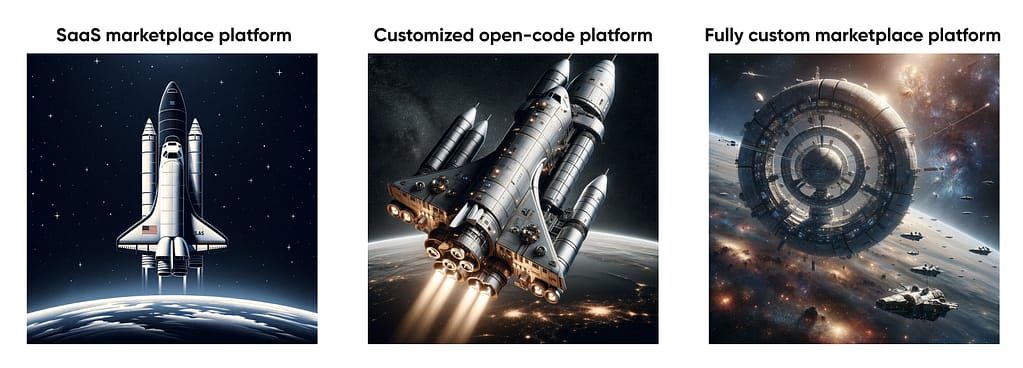
Developing a multi vendor marketplace is like any good journey—it starts with choosing your path. Whether you’re looking to quickly test the waters, tailor-make your dream platform, or build something groundbreaking from the ground up, there’s a route for you. And of course each route has its cost.
We have a detailed guide on strategies for Multivendor marketplace development—take a look. Here’s a breakdown so you get the idea:
1. SaaS marketplace platform. A hosted platform can reduce initial setup work. Budget for the subscription, payment fees, integrations, and any development permitted by the platform. Check how pricing and available features change as your seller count and transaction volume grow.
2. Self-hosted marketplace software. You license marketplace software and arrange hosting separately. This gives your team more control over hosting, integrations, and custom development. Budget for the software license, hosting, implementation, maintenance, and upgrades. CS-Cart Multi-Vendor is an example of this approach.
3. Custom development from scratch. A team builds the marketplace application for your requirements. This can suit unusual business models, but the budget must cover discovery, design, engineering, testing, security, hosting, and continued maintenance.
Compare the total cost over several years, including operating costs, before choosing an approach.
Breaking Down Multi-Vendor Marketplace Development Costs
The overall cost of building a marketplace website can vary significantly depending on whether the project uses SaaS software, a self-hosted platform, or fully custom marketplace development.
Starting a multi-vendor eCommerce platform doesn’t come with a fixed price. If you’re exploring how to build a marketplace app, understanding the cost of different approaches—SaaS, self-hosted, or custom development—is essential. The cost changes based on how complex your project is, how many special features you want, and how many extra services you need to add.
1. Custom Marketplace Development Costs
- MVP ($15,000 – $25,000): This step gets your multi-vendor website running. It covers basic setup on CS-Cart Multi-Vendor, focusing on essential eCommerce website features. This includes configuration of the built-in functionality and design, integration with payment systems, additional functionality of order delivery within selected time frames, and initial server setup.
- Marketplace with ERP Integration and Custom Basic Functionality ($50,000 – $100,000): Here, you integrate ERP software solutions for advanced inventory management, ensuring sellers can efficiently manage their stock. You’ll also add custom features, such as marketplace extensions, to enhance marketplace functionality and communication like SMS notifications.
- Fully Custom Project with Complex Integrations ($100,000 – $200,000): For a full-featured multi-vendor website, you’ll need to add advanced software for easy payment processing and lots of payment methods for your customers. You might also need special features made just for your site to help you make money in unique ways or to offer new services that set your marketplace apart.
2. Third-party Services Integration (avg. $3,500):
This includes adding external tools and software solutions to your platform for enhanced functionality, such as email marketing for promotions, live chat support for customer service, or financial software for easier bookkeeping.
3. Payment System Integration (from $1,200):
Integrating multiple payment options is crucial for convenient payment processing. This ensures customers can use their preferred payment method, whether it’s credit cards, PayPal, or newer digital wallets like crypto or crypto cards, enhancing the overall checkout experience.
4. Custom Design Creation (from $5,400):
A unique user interface design makes your multi-vendor platform visually appealing and easy to navigate. Investing in marketplace website design at this stage ensures your platform is both user-friendly and aligned with your brand’s visual identity. Custom design involves creating a distinctive look and feel that aligns with your brand, improving user engagement and making your marketplace memorable.
5. SEO Features (from $2,000):
Implementing SEO features is vital for making your eCommerce website easily discoverable online. This can include optimizing product descriptions for search engines, improving site speed for better user experience, and ensuring the site is mobile-friendly.
6. Custom Mobile App (native or PWA) (from $15,000):
Developing a custom marketplace mobile app (either a native app for iOS and Android or a Progressive Web App) extends the functionality of your marketplace to mobile users. This investment enhances accessibility and convenience, encouraging more engagement from shoppers and vendors.
7. Infrastructure and Server Audit (from $2,000):
Before launch, it’s important to ensure your multi-vendor eCommerce platform’s hosting infrastructure is robust and secure. An audit can identify potential issues with server capacity, security vulnerabilities, or performance bottlenecks, ensuring a smooth launch and reliable operation.
Investing in these areas lays a solid foundation for a successful multi-vendor marketplace. Each cost contributes to creating a platform that’s attractive to vendors and shoppers alike, balancing functionality, aesthetics, and performance.

“When customers approach us with questions like how much it would cost to develop a marketplace similar to Etsy, we dive deep into an investigation. There’s no fixed price tag because every project is unique, demanding different budgets,” explains Julia, our Head of Sales. “We take the time to understand our customers’ goals, needs, and ideas, crafting the best development strategy and solutions tailored to them. At CS-Cart, we adopt a flexible pricing approach, treating each project and customer with the personalized attention they deserve.”
Breakdown of Approximate Marketplace Development Costs
| Development service | Cost |
|---|---|
| Marketplace MVP | $15,000 – $25,000 |
| Marketplace with ERP integration and custom basic functionality | $50,000 – $100,000 |
| Fully custom marketplace with complex integrations | $100,000 – $200,000 |
| Third-party services integration | avg. $3,500 |
| Payment system integration | from $1,200 |
| Custom design creation | from $5,400 |
| SEO features | from $2,000 |
| Custom mobile app (native or PWA) | from $15,000 |
| Infrastructure and server audit | from $2,000 |
Considering Ongoing Operational Costs
After your marketplace is up and running, there are ongoing costs you need to plan for. These keep your site working well and help it grow.
1. Maintenance, Updates, and Scaling:
- Costs: Costs for maintaining an eCommerce website can start from $10,000 per year for a medium-sized company.
- Why it’s important: Your site needs regular check-ups and fixes to work smoothly. As your marketplace grows, you’ll need to upgrade it so it can handle more vendors and customers. Some marketplaces also choose to integrate MRP software to support vendors in optimizing material planning and production workflows.
2. Customer Support Infrastructure:
- Costs: This can vary, but setting aside $1,000 to $5,000 a month is a good start. If you’re planning to expand your customer service department, remember that hiring a customer service representative in the US may cost between $25,000 and $45,000 annually. Additionally, the average hourly salary for outsourced customer support services in the US varies from $15 to $25.
- Why it’s important: Good customer service keeps users happy. You need a team or tools to help answer questions and solve problems.
3. Marketing and Vendor Management Expenses:
- Costs: eCommerce companies typically spend between 6-20% of their gross revenue on marketing, with newer companies and those with less than $5 million in revenue potentially spending more. Vendor management might cost less but expect to spend based on the number of vendors.
- Why it’s important: Marketing gets your marketplace noticed. Managing vendors well ensures they’re happy and their products meet your standards.
Including these costs in your budget helps you keep your marketplace running without surprises. It’s all about planning ahead so you can focus on making your marketplace a success.
What Etsy’s Spending Shows About Marketplace Costs
Etsy illustrates why marketplace spending continues long after launch. In its 2025 annual report, Etsy Inc. reported $914.8 million in marketing expenses and $450.2 million in product development expenses. These are company-wide figures, not a suggested budget for a new marketplace. They show that attracting buyers and improving the product are continuing costs (ETSY).
Etsy’s seller pricing is another reminder to model marketplace economics carefully. Its transaction fee is currently 6.5% of the listing price plus amounts charged for shipping and gift wrapping; payment processing and some other fees are separate. A new marketplace should calculate how its own commissions, payment fees, refunds, marketing costs, and seller support affect its margin (Etsy).
Etsy’s scale and spending cannot be used to estimate the cost of launching a new marketplace. Use its reporting to identify cost categories, then build projections from your own expected orders, sellers, and acquisition costs.
How to Plan a Marketplace Budget in 2026
The cost of launching a multi-vendor marketplace in 2026 depends on the business model, target jurisdictions, payment architecture, seller workflows, integrations, customization, and expected scale. A ready-made marketplace platform can reduce initial development work, while custom development may be justified by unusual workflows or complex integrations.
Build the budget in separate layers: discovery and validation, platform and implementation, integrations, compliance and security, infrastructure, launch marketing, support, and ongoing maintenance. Treat published development ranges as illustrative estimates rather than universal market prices, and model total cost of ownership over at least three years.
The most reliable approach is to define a narrow MVP, validate buyer and seller demand, document the required payment and compliance flows, and add custom functionality only after the marketplace shows evidence of demand.
Remember, investing in a multi-vendor marketplace is not just about launching it but also about sustaining and growing it. Careful planning, strategic investment, and constant improvement are key to turning your marketplace into a thriving online community.
Discover the cost of developing your marketplace:
Q&A Section: Starting a Multi-Vendor Marketplace in 2026
What makes the cost of starting a multi-vendor marketplace go up or down in 2026?
The cost to start a multi-vendor marketplace website in 2026 changes based on a few big things. This includes the type of multi-vendor marketplace software you choose (like SaaS, self-hosted, or something made just for you), how complex your site is, following laws for online marketplaces, adding different ways to pay, making the site look good and easy to use, getting your site found on Google, and keeping your site running smoothly and safely.
How do laws like GDPR, CCPA, and PCI DSS change the cost of running a multi-vendor marketplace?
Following laws for data safety and payments is a big deal for online marketplaces. It means spending money on secure payment systems and keeping customer information safe. If you don’t, you could face big fines and lose your customers’ trust, which could cost you even more in the long run.
What’s the difference in cost and benefits between using a SaaS platform, self-hosted software, or building from scratch for my multi-vendor marketplace?
Choosing a SaaS platform for your multi-vendor marketplace solution can save you money upfront and get your marketplace owners selling faster, but you might not be able to change things as much as you want. Self-hosted software lets you customize more, but it costs more and you need to know how to keep it running. Building a multi-seller marketplace platform from scratch gives you all the control but takes a lot of time and money.
What are some surprises and tough parts about making a multi-vendor marketplace?
When building a multi-vendor marketplace model, you might run into issues like adding many ways to pay, meeting legal rules in different places, keeping the site safe, and setting up taxes right. Costs can go up unexpectedly if you need to add more features, pay more for keeping the site running, or deal with legal stuff you didn’t expect.
How does adding different payment options affect my multi-vendor marketplace?
Having various payment options is key for a good shopping experience in multi-vendor marketplaces. It makes shoppers happy and builds trust in your online marketplace. If it’s not done right, it can cause problems with payments and make people think twice about your marketplace.
Why is SEO important for my multi-vendor marketplace, and how much should I spend on it?
SEO helps people find your multi-vendor marketplace website easily on Google, bringing more visitors and sales. Spending money on SEO means making sure your site and products show up in searches, works fast, and looks good on phones. It’s a must for growing your site and should be part of your budget from the start.
Looking at Etsy, how crucial is marketing for growing a multi-vendor marketplace, and what should my budget be?
Just like Etsy, spending on marketing is super important for getting more buyers and sellers to your online marketplace. How much you spend can change based on how big your marketplace is and who you want to reach, but usually, it’s between 6-20% of what you make. Start-ups might spend more to get noticed. This money goes into ads online, social media, blogs, and working with influencers to get the word out to your target audience.
All CS-Cart Products and Services
- ★ CS-Cart Multi-Vendor: free online demo
- ★ CS-Cart Store Builder: free online demo
- ★ Mobile App: App Store, Google Play
- ★ Cloud Hosting: why it’s the best for CS-Cart
- ★ Customer Care: why it’s more than just a tech support
- ★ Upgrade subscription: select and reactivate

eCommerce expert with 10+ years of experience in marketplace management and consumer behavior. Gayane tracks the latest industry trends to provide businesses with analytical, actionable insights.