Your first marketplace launch might involve a few dozen sellers and a straightforward checkout. Your growth plan could involve several countries, supplier integrations, different commission rules, and a team managing thousands of orders.
The platform you choose needs to support both stages—and give you a realistic way to move between them.
CS-Cart Multi-Vendor and Arcadier both provide marketplace infrastructure. Their current offerings, however, take different approaches to deployment, customization, and pricing. CS-Cart offers an installable marketplace platform with published license prices. Arcadier emphasizes a managed marketplace engine that connects to your existing technology through APIs.
This comparison explains what those differences mean for your launch budget, day-to-day operations, and next phase of growth.
Marketplace Growth Makes Operating Decisions More Important
Marketplace growth is measurable, although no industry statistic can predict an individual project’s results. In its 2025 business results, Mirakl reported $14.6 billion in marketplace and dropship GMV, up 31% year over year, and more than 35 customers exceeding $100 million in GMV. These figures describe Mirakl’s customer ecosystem, including dropship activity—not the entire marketplace industry.
As transaction volume grows, small operational problems become expensive. A seller who manually updates stock once a week can create overselling. An unclear refund process can turn into a daily support burden. A commission structure that works for one category may become unsuitable when you add another.
That is why a useful platform comparison starts with how your business will operate at scale.
Cs-Cart Vs Arcadier At A Glance
| Decision | CS-Cart Multi-Vendor On-Premises | Arcadier |
| Deployment approach | Installable software with separately arranged hosting | Cloud marketplace engine; client-hosted frontend options |
| Commercial model | Published annual subscriptions and lifetime licenses | Custom pricing based on deployment, growth, and complexity |
| Starting software price | Standard: $725/year (See CS-Cart pricing) | No public starting amount on the current pricing page (See Arcadier pricing) |
| Feature packaging | Capabilities vary by edition | Current pricing page states there are no feature gates |
| Integration approach | REST API, add-ons, and custom development | API-first platform, webhooks, and connectors |
| Typical decision driver | Ready marketplace operations and a published software budget | Marketplace integration into an existing digital ecosystem |
The decision drivers are our assessment of these offerings.
Deployment: Who Runs Your Marketplace Infrastructure?
CS-Cart: an installable platform

CS-Cart Multi-Vendor On-Premises is deployed on hosting arranged for your project. This lets you choose an infrastructure provider and organize maintenance around your team’s requirements. CS-Cart also offers access to its App Market for additional functionality.
This approach can suit a business that wants to coordinate software development, hosting, and integrations through its own team or chosen partners. It also creates operational responsibilities: someone needs to manage backups, updates, monitoring, and the compatibility of custom modifications.
You do not necessarily need an internal infrastructure team. You do need a clear agreement about who performs that work and what it costs.
Arcadier: a managed engine with flexible frontends

Arcadier’s documentation describes a move toward API-first development, client-hosted frontend options, and a delivery model centered on solution design and integration. Its February 2026 update explicitly says the platform has evolved beyond its original self-service marketplace builder model.
For a company with an existing application or customer portal, this is a relevant distinction. The marketplace can become an additional capability within that environment. The implementation still needs people responsible for frontend development, integration failures, and ongoing changes.
Pricing: Compare The Complete Operating Budget
CS-Cart publishes its software prices
The current On-Premises annual subscriptions are:
| Edition | Annual software price |
| Standard | $725 |
| Plus | $1,449 |
| Ultimate | $3,599 |
Lifetime licenses are listed at $3,590 for Plus, $7,990 for Ultimate, and $19,990 for Unlim. Included support and update periods differ by license. A lifetime license does not eliminate hosting, maintenance, or future development expenses (See the CS-Cart product documentation for more information about each edition scope).
CS-Cart’s pricing page states that On-Premises has no platform transaction fee and no restrictions on product or user numbers. Hosting and payment processing remain separate expenses.
For budgeting, separate the software license from the launch project. Design, data imports, integrations, and unusual workflows can change the total substantially.
Get more information from: Multi-Vendor Marketplace Development: How Much Does It Cost to Launch a Marketplace in 2026
Arcadier Prices The Project And Ongoing Relationship
Arcadier’s current pricing page does not publish a fixed entry price. It separates the commercial proposal into one-time setup, monthly platform access, monthly management and maintenance, and pay-as-you-go technical support. Managed development services are quoted separately.
It also says transaction fees are not its default and that core features are not gated by plan. This makes the actual proposal essential: ask which usage assumptions affect recurring costs, what support includes, and how fees change when your marketplace grows.
Neither approach proves which platform will be cheaper for your project. A credible comparison requires the same implementation scope and growth assumptions.
Read also: Best Marketplace Platform: Top 17 Marketplace Software
Build a Three-Year Cost Model
Estimate the following for both options:
- Software or platform access.
- Initial configuration, design, and migration.
- Hosting and infrastructure management.
- Payment processing and payout costs.
- Integrations, extensions, and custom development.
- Support, updates, and ongoing maintenance.
For illustration, three years of CS-Cart Standard at an unchanged $725 annual rate would total $2,175 in software subscriptions. That is a calculation, not a three-year price guarantee or an estimate of the complete operating cost.
Ask Arcadier to price the same three-year scenario. Include your expected seller count, catalog size, order volume, integrations, and support requirements.
Seller Management And Payments: Test The Real Money Flow
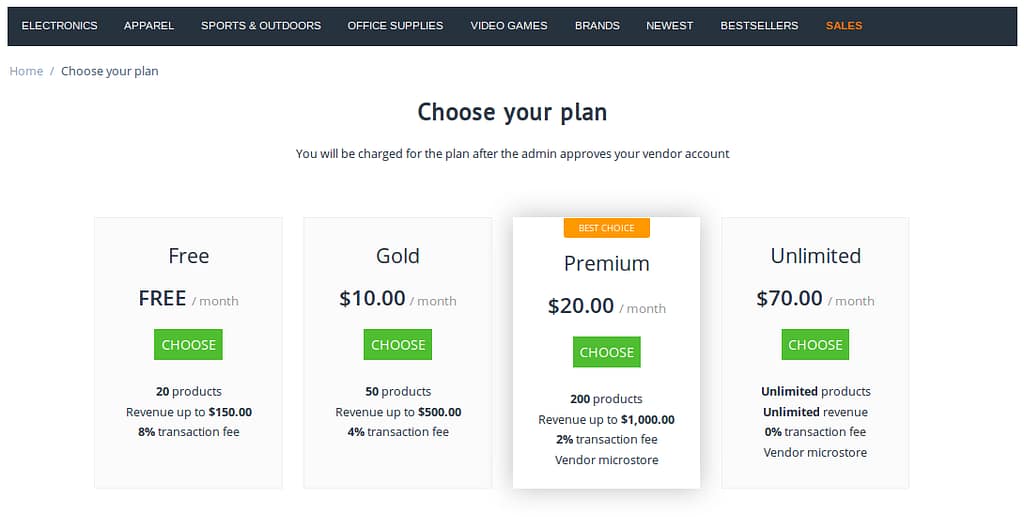
CS-Cart’s Vendor Plans let operators define seller subscriptions with conditions such as product, revenue, and category restrictions. Its money-flow documentation also describes periodic fees and order commissions. Importantly, Vendor Plans track fees; they do not distribute money by themselves. Automatic distribution is available through supported marketplace payment integrations, including Stripe Connect and PayPal Complete Payments, subject to seller eligibility.
Read more: What Is Stripe Connect? How Marketplaces Use It to Manage Payments
Arcadier provides separate administrator, merchant, and buyer portals. Its documentation describes merchant approval, inventory or service availability management, order processing, and multi-merchant checkout. Default portals are available, while developers can also build custom experiences through the API.
These capabilities need a practical demonstration. Ask both providers to walk through a purchase from two sellers, followed by a partial refund and a seller payout. Check who receives the original payment, how commissions change after the refund, and what the operator must reconcile manually.
For international expansion, repeat that exercise with sellers in your intended countries. A payment integration’s presence does not establish that every seller can use it.
Customization And Integrations: How Will The Next Change Happen?
CS-Cart documents REST API access for entities including products, orders, shipments, users, and vendors. Access is governed by user permissions. This provides an integration route for external systems; the precise capabilities and permissions should be checked against your selected edition.
Arcadier’s platform page describes webhooks for connecting CRM, ERP, and order management systems, native Stripe connectivity, and external payment gateway integration through APIs. Its homepage advertises 150+ REST endpoints. That is a vendor-reported measure of API coverage, not a performance benchmark.
To compare implementation effort, give both teams one difficult requirement—for example, supplier stock synchronization with failed-update recovery. Ask what exists already, what requires development, who maintains it, and how it is tested after updates.
Growth Evidence: What Customer Projects Actually Show
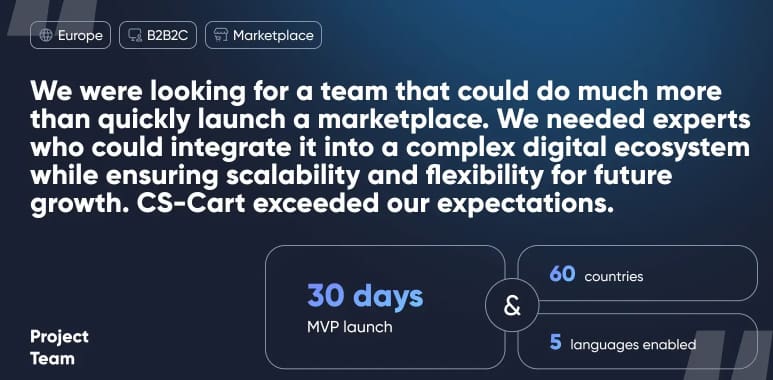
CS-Cart’s water filtration marketplace case study reports an MVP launch in 30 days and integration with an existing authentication ecosystem serving 99,000 users. The project also involved cross-selling, premium vendor storefronts, and multilingual functionality.
Read the full CS-Cart Water Filtration Case Study

Arcadier’s BCAA case study describes a used-car marketplace for an association serving more than one million members. The implementation included identity verification to support trust between participants. That membership figure is the association’s audience, not the marketplace’s active user count.
Which Platform Fits Your Growth Plan?
Consider CS-Cart Multi-Vendor On-Premises if you want an installable marketplace platform, published software prices, and a launch based on existing commerce functionality. It is especially worth evaluating when your team or implementation partner can take responsibility for hosting and ongoing maintenance.
Consider Arcadier if your marketplace needs to fit into an established digital ecosystem, custom frontend experiences are important, and you prefer a scoped platform and delivery relationship. Evaluate its proposal against your integration requirements and expected recurring costs.
Before deciding, write down three stages: launch, your first meaningful increase in order volume, and expansion into another market or business model. For each stage, identify the required workflows, integrations, support, and budget.
Then ask each provider to demonstrate that plan. The platform that fits your growth is the one your team can operate today and change affordably when the business evolves.

eCommerce expert with 10+ years of experience in marketplace management and consumer behavior. Gayane tracks the latest industry trends to provide businesses with analytical, actionable insights.